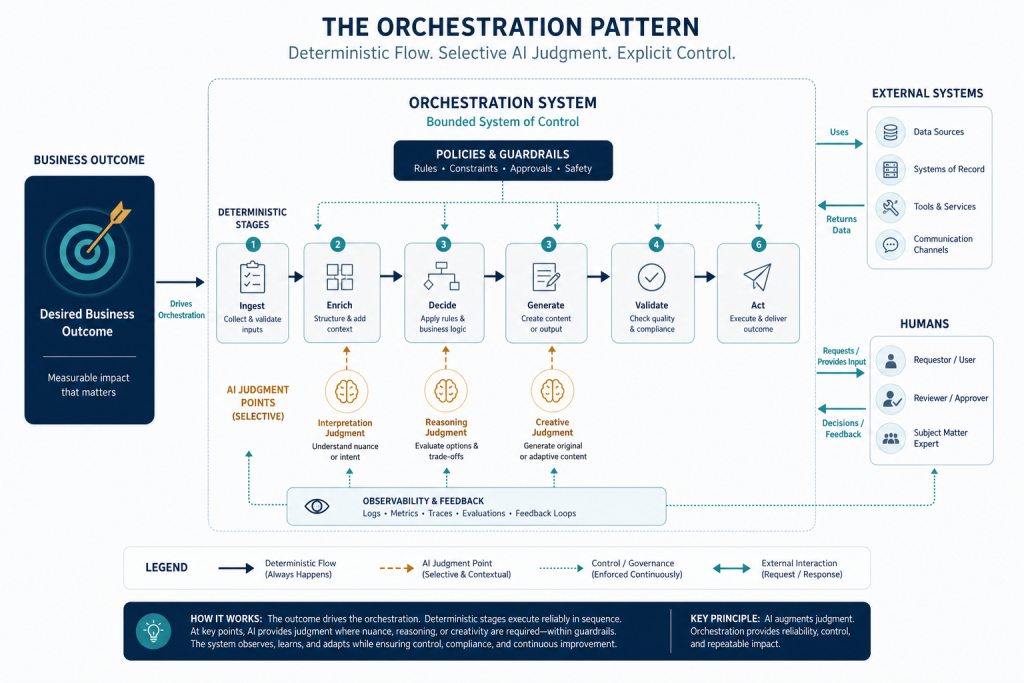
Why this matters: Agency belongs at bounded decision points where unstructured evidence must be interpreted under uncertainty and the result can be checked. It does not belong by default in policy enforcement, authorization, validation, calculation, or irreversible execution. This lesson equips learners to produce an agency-placement matrix and a simpler-alternative assessment that can withstand a Decision Lab stakeholder review.
What you will be able to do
- Distinguish deterministic workflows, AI-assisted workflows, bounded agents, agentic workflows, and multi-agent systems by who chooses the next action and how control is enforced.
- Complete an agency-placement matrix that assigns each process step to deterministic logic, bounded model judgment, approval, or manual handling.
- Specify state ownership, legal transitions, model and tool contracts, permissions, data boundaries, and termination states.
- Use a simpler-alternative assessment to defend why an agentic design is or is not justified under reliability, cost, latency, volume, security, and governance constraints.
Begin with the failure you must prevent
Constrained brief: An operations leader says, “We receive thousands of messy employee messages. Let an agent handle the whole request end to end.” That sounds efficient until the first message says, “My baby arrived last month—please add her and make coverage effective immediately.” The message may be incomplete, may refer to a policy deadline, and may request a change that affects coverage and payroll deductions. A fluent model response is not evidence that the request is eligible, authorized, or safe to execute.
Your architectural task is therefore not to ask, “Can an agent do this?” Ask: Which exact decision needs contextual judgment, what evidence may support it, what outcomes are legal, and what controls must independently decide whether an action occurs?
Start with a process decomposition map. For every step, name: input; state read; decision owner; permitted transition; output; external side effect; and terminal condition. In the fictional Northstar case, inbound-message normalization, employee lookup, deadline calculation, eligibility rules, authorization, and request submission are candidates for deterministic services. Interpreting informal language, extracting an asserted life event, and drafting a clarification request are candidates for bounded model assistance.
This distinction matters because model-selected actions, deterministic application logic, and actual tool execution are three separate events. The model might emit a structured proposal: event=birth; confidence=0.76; missing_document=proof_of_birth; recommended_route=request_clarification. The application then validates the schema, checks whether that route is legal from the current state, evaluates policy rules, and confirms permissions. Only a tool executor, using a narrowly scoped credential, performs an allowed external call.
Choose the simplest architecture that meets the decision need
Use these architecture labels precisely. They are a spectrum of control, not a maturity ladder.
| Pattern | What selects next work? | Use it when |
| Deterministic workflow | Explicit rules, state machine, or code | Inputs and outcomes are structured; rules can be encoded; auditability and repeatability dominate. |
| AI-assisted workflow | Workflow code; model supplies a bounded artifact | A model extracts, summarizes, classifies, or drafts, but cannot autonomously expand scope or execute consequential actions. |
| Bounded AI agent | Model selects among a small, declared set of legal actions within a turn or bounded loop | Contextual investigation or planning is useful, tools are limited, and stopping, budget, and escalation rules are explicit. |
| Agentic workflow | A durable orchestrator combines deterministic routing with one or more bounded model-decision points | Work crosses stages, waits for people or systems, requires recoverable state, and has meaningful uncertainty. |
| Multi-agent system | An orchestrator delegates to multiple specialized agents | Only when distinct roles, context boundaries, or parallel expertise demonstrably improve outcomes enough to justify coordination overhead. |
Multiple agents are optional, not the definition of agentic. If a classifier plus rules resolves the work, adding a planner, researcher, and executor creates more prompts, state handoffs, traces, failure modes, latency, and attack surface without adding control.
A useful test: if you can enumerate the next action using stable inputs and a comprehensible rule table, do that. If the real work is converting ambiguous language into a checkable structured hypothesis, use AI assistance. If the task requires choosing among a small set of investigative actions whose value depends on the evolving context, consider one bounded agent. Do not infer that open-ended autonomy is needed merely because the input is prose.
Place agency with an explicit matrix
Build an agency-placement matrix before selecting a framework. Score each process step qualitatively across ambiguity, reversibility, policy codifiability, evidence quality, consequence, action scope, volume, and required latency. Then choose the minimum-control-sufficient mechanism.
| Northstar step | Placement | Reason and control |
| Parse email format; deduplicate message | Deterministic | Known formats and stable identifiers; reject malformed input. |
| Infer whether “new arrival” means birth, adoption, or casual language | AI-assisted extraction | Ambiguous language; output restricted to an enumerated schema with evidence spans. |
| Calculate enrollment deadline | Deterministic | Date arithmetic and plan rules must be reproducible and testable. |
| Determine eligibility | Deterministic policy engine | Rules, plan version, employee status, and dates are authoritative inputs. |
| Find missing documents | Bounded agent or model-assisted retrieval | Useful only if it can search an approved document index and return citations to retrieved records; never invent evidence. |
| Submit coverage change | Deterministic executor after approval | External side effect; validate eligibility, authorization, document status, and an idempotency key; require human approval under the defined policy. |
Model-driven routing is justified when categories cannot be economically maintained as rules, the route has a small allowed set, supporting evidence can be retained, and a downstream verifier can catch unacceptable proposals. It is weakly justified when the desired route merely saves a few deterministic steps, when labels are stable enough for conventional classification, or when the failure cost is high but evidence cannot be independently verified.
Keep authorization, identity matching, numeric calculations, record retention, entitlement enforcement, and final approval deterministic where practical. For high-consequence actions—payments, benefit elections, account deletion, production changes, legal commitments, privileged access, disclosures of sensitive data—separate preparation from execution. A model can assemble a case; it must not be the sole authority that grants itself access or performs the act.
Turn the design into enforceable contracts and boundaries
Now specify a legal state machine. State belongs in a durable workflow store or database keyed by a workflow ID, not only in the model conversation. Keep structured fields such as request_id, employee_ref, plan_version, extracted_event, evidence_refs, eligibility_result, approval_status, selected_route, tool_attempts, idempotency_key, and audit_events. Store references to sensitive documents when possible instead of duplicating their contents across prompts and logs.
For Northstar, legal transitions are: received → normalized → extracted → policy_checked → awaiting_employee → policy_checked; or policy_checked → awaiting_reviewer → approved_for_submission → submitted → closed. Terminal states are closed_completed, closed_ineligible, closed_withdrawn, closed_escalated, and closed_failed. The application router—not the model—enforces that an extracted event cannot jump directly from received to submitted.
Define a contract for the model decision point. Input: approved message text, approved retrieval snippets, policy version identifier, and allowed routes. Output: strict JSON containing an event enum, normalized facts, cited evidence spans, missing-information enum, confidence band, and recommended route enum. Reject extra fields, unsupported route values, absent evidence, or contradictions with authoritative records. Structured function or tool arguments can be constrained to a schema on supported configurations, but schema adherence is not business correctness; validation remains application responsibility. ([help.openai.com](https://help.openai.com/en/articles/8555517-function-calling-in-the-openai-api?utm_source=openai))
Give the agent no direct third-party-administrator credential. Instead, expose a single application tool such as prepare_change_request(request_id) and a separate executor available only after deterministic preconditions and, where policy requires it, a human decision. Apply least privilege by tenant, employee record, document class, and action. Redact or minimize sensitive data in prompts, protect state and traces under access controls, and record why a reviewer approved or rejected the request.
Make the case against agents before building them
Agentic orchestration is often the wrong solution for economic as well as safety reasons. Use the simpler-alternative assessment below. Prefer a deterministic workflow when rules cover the common path and exceptions can be routed to a queue. Prefer AI assistance when the model’s work ends in a draft, extraction, or nonbinding recommendation. Prefer a bounded agent only when it materially reduces unresolved cases through context-sensitive tool selection and can be contained by a small action set.
| Signal | Why agency is a poor fit | Better first design |
| High volume, low variation | Per-request model cost and latency accumulate; errors repeat at scale. | Rules, templates, conventional extraction, batch processing. |
| Stable policies and structured inputs | Model judgment adds variance without information gain. | State machine plus policy engine. |
| Near-zero tolerance for incorrect action | Verification may cost more than automation saves. | Human-operated queue with AI drafting only. |
| Few exceptions and cheap manual handling | Agent build, evaluation, tracing, and governance costs exceed benefit. | Ordinary automation with escalation. |
| Strict latency or throughput budget | Multi-step deliberation, retrieval, and tool loops are variable and slow. | Precomputed rules; asynchronous review for exceptions. |
| Cannot define permissions, data boundary, or evaluator | Unbounded scope is not a solvable prompt problem. | Do not automate the decision yet; improve data and controls first. |
State the uncertainty honestly. You may hypothesize that a bounded retrieval-and-clarification agent reduces manual triage, but you do not yet know. Test it against representative synthetic cases: straightforward birth event; ambiguous “new arrival”; conflicting dates; missing proof; duplicate email; unauthorized sender; third-party API timeout; reviewer rejection; and an attempted duplicate submission. Compare deterministic-only, AI-assisted, and bounded-agent variants on route correctness, evidence sufficiency, unsafe-action rate, human-review load, end-to-end latency, cost per resolved request, and trace completeness. Establish a release criterion such as: no unauthorized execution in the test set; every side effect linked to an approval and idempotency key; and every failed run reaches a defined recoverable or escalated terminal state.
Practice: Agency-Placement Matrix and Simpler-Alternative Assessment
Scenario: Applied practice scenario — Fictional and synthetic: You are designing intake for “Northstar Benefits,” a fictional employer-benefits administrator. HR uploads employee messages about life events such as marriage, birth, address changes, and coverage questions. The system must classify the request, identify missing evidence, draft a response, and—only when authorized—submit a benefits-change request to a third-party administrator. No actual employee, health, or benefits data is used in this exercise.
Create two portfolio artifacts for the fictional Northstar scenario. Deliverable 1: an agency-placement matrix with at least eight steps and columns for task property, decision owner, state read/write, legal transitions, data classification, permitted tool, approval need, failure mode, and rationale. Deliverable 2: a one-page simpler-alternative assessment comparing deterministic workflow, AI-assisted workflow, and one bounded-agent design. Choose one and defend it using reliability, cost, latency, throughput, privacy/security, maintainability, and governance tradeoffs. Add a transition specification for at least five states; a model-output JSON schema; an approval matrix; retry/timeout/idempotency rules for the third-party submission; and ten synthetic test cases. Finish with a trace map that shows which fields let an operator reconstruct a wrong route, a rejected approval, a retry, and a duplicate-action prevention. Add both artifacts to your Agentic Workflow Systems Portfolio as an “Architecture Decision Package” for use in Decision Labs.
Self-review checklist
- I decomposed the process into steps, triggers, data, decisions, side effects, and terminal states.
- I identified who or what chooses each legal next step and separated model proposals from application routing.
- I placed workflow state in a named durable system of record and defined checkpoint fields.
- I assigned deterministic validation, authorization, and approval gates before every consequential side effect.
- I specified tool contracts, least-privilege permissions, data boundaries, timeout behavior, retry classes, idempotency keys, and compensation or escalation paths where needed.([docs.aws.amazon.com](https://docs.aws.amazon.com/durable-execution/patterns/best-practices/idempotency/?utm_source=openai)) ([docs.aws.amazon.com](https://docs.aws.amazon.com/durable-execution/patterns/best-practices/step-design/?utm_source=openai))
Module capstone: apply the module in the AI Agentic School Decision Lab below. Mastery unlocks the LearnDash completion control for this topic.
AI Agentic School Decision Lab
Please sign in to submit your module decision and receive feedback.
Key takeaways
- Agency is a placement decision, not a default architecture: reserve model judgment for ambiguity, contextual interpretation, and constrained planning.
- A model may recommend a route or propose a tool call; deterministic application logic must validate that proposal against policy, permissions, schemas, and workflow state before any tool executes.
- For irreversible, regulated, financial, identity, access-control, or high-impact actions, use deterministic controls and often a human approval gate—even if an AI helped prepare the case.
- Retries do not make side effects safe. Design idempotency keys, checkpoints, timeout rules, compensation, and escalation before enabling automated execution.
- The strongest design is often ordinary automation or an AI-assisted workflow rather than an agentic workflow.
Useful terms
- Agency placement
- The deliberate assignment of a process step to deterministic logic, bounded model judgment, human review, or manual execution based on uncertainty, consequence, and controllability.
- Bounded agent
- A model-driven component that can select only from declared actions, tools, permissions, routes, and budgets, with explicit stop and escalation conditions.
- Deterministic router
- Application logic that checks state and policy and selects only legal next workflow transitions; it does not simply obey a model recommendation.
- Idempotency key
- A stable identifier supplied to a mutating operation so repeated delivery or retry does not create an additional business effect.
Research & review note
This lesson is built from source-traceable research and reviewed before publication. AI Agentic School uses AI as a research and practice tool, not as a substitute for evidence or editorial judgment.