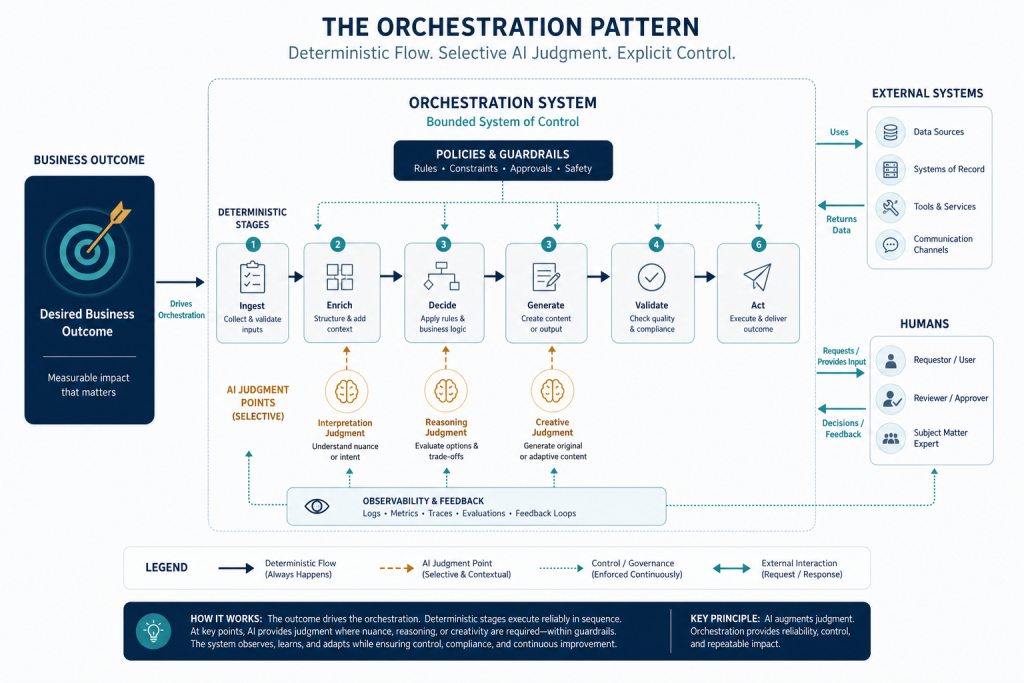
Why this matters: Frame agency as one controlled capability inside a larger process. Before choosing an agent framework, specify the business outcome, system boundary, authoritative state, legal transitions, approval gates, failure endings, and evidence needed to judge success. The resulting boundary prevents a useful AI component from turning into an undefined general-purpose operator.
What you will be able to do
- Write a bounded outcome statement that distinguishes intended terminal outcomes from excluded work.
- Create a system and data boundary that identifies workflow owner, authorities, dependencies, and durable state.
- Select an appropriate architecture—deterministic, AI-assisted, bounded agentic, or multi-agent—and defend the choice.
- Specify legal transitions, decision owners, model/tool contracts, approval gates, and terminal conditions for a cross-system workflow.
1. Start with a constrained outcome, not an agent
Decision brief. The CIO asks for an “AI agent that handles access requests.” That request is dangerous as written. If the team starts with a chat interface and a broad set of tools—search HR, inspect policy, create accounts, send email—the orchestration layer can quietly become an unbounded operator. The first architecture decision is not which model or framework to use. It is whether the end-to-end process needs agency at all, and exactly where ambiguity is worth delegating.
For the fictional access-request process, write this outcome statement:
When an authenticated employee submits an access request, the Access Operations workflow owner ensures the request reaches one recorded terminal outcome—provisioned, denied with policy reason, withdrawn, expired, or escalated—while applying current entitlement policy, preserving an auditable decision trail, and requiring the designated human approvals before any access-changing action.
Notice what this excludes: the workflow does not invent entitlements, negotiate exceptions, change policy, resolve identity conflicts autonomously, or make broad HR data available to a model. Those are separate processes or human decisions. An outcome is therefore a contract about completion and non-completion, not an aspiration such as “help employees get access quickly.”
Now decompose the brief into six boundary questions: who owns the outcome; what event creates a workflow instance; what terminal states are valid; what systems may be read; what systems may be changed; and what is expressly excluded. Add a seventh question: what evidence must remain after completion so an auditor or operator can reconstruct what happened.
2. Put agency behind a narrow decision boundary
Classify the architecture before adding autonomy. A deterministic workflow has fixed steps and rules: validate identity, check whether an application is on an approved catalog, calculate required approvers, and transition according to policy. An AI-assisted workflow inserts model output into a deterministic process, for example extracting the requested application and business justification into a schema; application code still chooses the branch.
A bounded AI agent may choose among a small, declared set of information-gathering or drafting actions to achieve a local goal, subject to time, token, tool, and permission limits. An agentic workflow combines such bounded judgment with durable state, deterministic guards, routing, tool execution, approvals, recovery, and terminal outcomes. A multi-agent system is simply an agentic design with more than one agent; it is not inherently more capable, safer, or necessary.
For this scenario, choose an AI-assisted workflow first. The model may normalize the request and identify ambiguity; deterministic policy logic calculates eligibility and required approvals. This is stronger than a general-purpose access agent because entitlement rules, authorization, and state transitions are testable and stable. It is also cheaper and lower latency than using an agent loop for every request. A bounded agent becomes justified only if the request routinely requires multi-step evidence gathering from a limited, read-only set of approved sources—and its proposed actions remain reviewable.
| Question | Control decision |
|---|---|
| Who chooses next step? | State-machine router; model supplies only typed interpretation or recommendation. |
| What is model-driven? | Application-name extraction, ambiguity flag, and justification classification. |
| What is deterministic? | Identity validation, policy lookup, approval calculation, authorization, transitions, and termination. |
| What executes tools? | Application service after validation and permission checks—not the model itself. |
Structured outputs are useful here because they constrain model-produced data to a developer-supplied schema; they do not establish that the extracted application, policy interpretation, or authorization is correct. Validate the schema, then verify the claims against authoritative sources. ([openai.com](https://openai.com/index/introducing-structured-outputs-in-the-api/?utm_source=openai))
3. Establish authority, data minimization, and durable state
Draw the system boundary and place state deliberately. Make four lanes in your process decomposition map: requester and human actors; workflow/orchestration service; authoritative business systems; and external dependencies. The identity provider is authoritative for authenticated subject and current identity attributes. The entitlement-policy service is authoritative for rules and application ownership. The identity-management system is authoritative for actual granted access. The ticketing system is authoritative for the request record and final status. The workflow engine holds durable execution state: request ID, current state, approved evidence references, attempt counts, approval deadlines, idempotency keys, and immutable event references.
Do not make the prompt transcript, model context window, vector store, or agent-framework memory the authority for whether access was approved or provisioned. They may hold minimized working context or retrieval aids, but they can be stale, incomplete, mutable, retention-sensitive, or unavailable during recovery. Store references and compact, necessary state in the workflow; resolve current policy and entitlement facts from their systems of record at the controlled decision point. Durable workflow patterns likewise distinguish replayable orchestration from non-deterministic operations and recommend checkpointed steps rather than letting external reads or side effects leak into uncontrolled control flow. ([docs.aws.amazon.com](https://docs.aws.amazon.com/durable-execution/patterns/best-practices/determinism/?utm_source=openai))
Write a data-boundary plan. Permit the model to receive request text, a pseudonymous requester role, and a policy excerpt selected by deterministic retrieval. Exclude salary, performance records, medical information, unrelated tickets, and credentials. Give the model no direct token for provisioning. The provisioning service receives only the validated subject ID, application ID, approved role, approval record IDs, and a stable idempotency key.
4. Contract transitions, tools, and approval gates
Specify the legal state machine. Use explicit states: Received → Validated → Interpreted → PolicyEvaluated → AwaitingApproval → AuthorizedToProvision → Provisioning → Verified → Closed. Alternative terminals are Denied, Withdrawn, Expired, and Escalated. Illegal transitions matter: Interpreted → Provisioning is forbidden; AwaitingApproval → AuthorizedToProvision requires valid recorded approvals; Provisioning → Closed is forbidden until a deterministic verification read confirms the intended entitlement.
Create a transition specification for every arrow: entry predicate, decision owner, inputs, output schema, timeout, audit event, and next allowed states. For example, the model returns {application_candidate, confidence_band, ambiguity_reason, requested_role}. Deterministic logic rejects unknown application IDs, routes low-confidence or multiple-candidate results to clarification, and calls policy only with a validated application ID. The model can select from labels in its schema; it cannot create a new branch, call a hidden function, or reinterpret an approval policy.
Separate three events in your trace: proposed action (the model suggests normalized application X), authorized command (policy and approval guards permit provisioning), and execution result (the identity API reports success or an error). This separation makes approval, debugging, and incident review possible. Function calling connects models to tools, but OpenAI’s guidance specifically notes that tool output can be untrusted and recommends confirmation before real-world-impacting actions; treat every tool boundary as a verification and authorization boundary. ([openai.com](https://openai.com/index/function-calling-and-other-api-updates/?utm_source=openai))
5. Make quality, recovery, and observability part of “success”
Define success as a scorecard, not one completion rate. For a pilot, establish target thresholds with the process owner; do not borrow generic benchmarks. Measure outcome quality: correctly resolved application and correct policy result, sampled against expert review. Measure completion: share reaching a valid recorded terminal state before the request deadline. Measure safety: unauthorized grants, wrong-subject grants, incorrect denials, policy-bypass attempts blocked, and duplicate provisioning events. Measure operations: p50/p95 end-to-end latency, per-request model and tool cost, queue age, throughput, timeout rate, and human intervention rate. Segment every measure by request type, ambiguity, application risk tier, and whether a model was used.
Design failure before rollout. A provision call can time out after the remote system performed the action. Retrying blindly can duplicate a grant or notification. Send a stable idempotency key, checkpoint the command intent and result, then reconcile with a read of the authoritative identity system before retrying. Retry transient read failures with bounded exponential backoff; do not automatically retry ambiguous or non-idempotent writes without reconciliation. Escalate unresolved state after a deadline to Access Operations, and use compensation—revoke the exact workflow-created entitlement—only when policy permits and the workflow can prove what it created. AWS durable-execution guidance warns that replay and retry can run side-effecting operations more than once and recommends idempotency keys, conditional writes, or deterministic event IDs; Step Functions documents explicit retry, timeout, and catch/fallback handling as workflow controls. ([docs.aws.amazon.com](https://docs.aws.amazon.com/durable-execution/patterns/best-practices/idempotency/?utm_source=openai))
Trace each run with a correlation ID, state transition, actor/model version, prompt/template version, input and output schema versions, policy version, approval IDs, tool request/result references, retry count, latency, cost estimate, and terminal reason. Redact or reference sensitive payloads rather than copying them into every trace. Review state-level history and failures, not only final outcomes; workflow systems expose execution and state details precisely because intermediate transitions are operational evidence. ([docs.aws.amazon.com](https://docs.aws.amazon.com/step-functions/latest/dg/concepts-view-execution-details.html?utm_source=openai))
Applied Practice: Boundary a Fictional IT-Access Request Workflow
Scenario: Fictional and synthetic scenario: You are designing an employee IT-access request workflow for a 2,000-person company. An employee submits a free-text request for access to a named application. The workflow may interpret the request, retrieve entitlement policy, determine whether manager and application-owner approvals are required, provision access through an identity-management API, and notify the requester. It must never let a model independently grant access, alter policy, or read unrestricted HR records.
<p><strong>Work product for your Agentic Workflow Systems Portfolio.</strong> Produce a two-page “Outcome and Boundary Packet” for the fictional scenario. Use synthetic request examples only; do not use actual employee, HR, credential, or entitlement data.</p><p><strong>Deliverable 1 — outcome card.</strong> Write a 90–130 word outcome statement naming: process owner, trigger, primary terminal outcome, alternate terminals, success deadline, required evidence, and five exclusions.</p><p><strong>Deliverable 2 — boundary map.</strong> Draw four lanes and label each system as authoritative record, evidence source, action target, workflow state store, or excluded system. For every data flow, state the minimum fields allowed and whether the model may see them.</p><p><strong>Deliverable 3 — transition and control table.</strong> Specify at least eight states. For each transition, identify the chooser of the next step, deterministic guard, model input/output schema if used, approval requirement, tool permission, timeout, retry/idempotency rule, audit event, and fallback or terminal route.</p><p><strong>Deliverable 4 — success and test plan.</strong> Define six measures across quality, completion, safety, cost, latency, and intervention. Create 12 representative test cases: clear request, ambiguous application name, unknown app, ineligible role, approval rejection, approval expiry, duplicate submission, identity mismatch, policy-service timeout, provision timeout with unknown outcome, malformed model output, and policy version change mid-flight. State expected terminal outcome and trace evidence for each.</p><p><strong>Decision Lab defense.</strong> In a short rationale, defend why this is AI-assisted rather than a bounded agent. Then state the one new recurring ambiguity or evidence-gathering need that would justify introducing a bounded read-only agent, along with its tool allowlist, budget, stop condition, and human escalation rule.</p>
Self-review checklist
- The outcome statement has one owner, one trigger, explicit terminal outcomes, and explicit exclusions.
- Every system and data source is classified as authoritative, read-only evidence, action target, or out of scope.
- The state diagram lists only legal transitions and assigns each transition to deterministic logic, model judgment, a human, or an external event.
- No model output can directly cause provisioning, denial, or notification without schema validation and application authorization.
- Each external side effect has an idempotency key, timeout, retry rule, checkpoint, and escalation or compensation path where needed.
Key takeaways
- An outcome statement is a control artifact: it names the owner, trigger, terminal condition, authority, exclusions, and measurable consequences of failure.
- Keep business truth in systems of record and durable workflow state; treat model context and framework memory as constrained working material, not authoritative business state.
- Use deterministic routing for policy, eligibility, permissions, and terminal decisions. Reserve model judgment for bounded interpretation, classification, extraction, or recommendation under a schema.
- A tool call proposed by a model is not an executed action. Application logic must validate the proposal, authorize it, execute it, record the result, and decide the legal next transition.
- Success is multi-dimensional: an apparently completed workflow can still fail on quality, safety, duplicate side effects, latency, cost, or excessive human intervention.
Useful terms
- Authoritative record
- The system designated as the source of truth for a particular business fact, such as actual access entitlement or current approval status.
- Bounded AI agent
- A model-driven component with a narrow goal, limited tools and permissions, explicit budgets, stop conditions, and controlled handoff paths.
- Checkpoint
- A durable record of workflow progress or a completed step result that supports recovery without losing the workflow’s place.
- Compensation
- A controlled corrective action intended to address an already-completed side effect, such as revoking an entitlement created by a failed workflow.
Research & review note
This lesson is built from source-traceable research and reviewed before publication. AI Agentic School uses AI as a research and practice tool, not as a substitute for evidence or editorial judgment.
Sources & further reading
- Introducing Structured Outputs in the API | OpenAI
- Determinism during replay – AWS Durable Execution SDK Developer Guide
- Function calling and other API updates | OpenAI
- Idempotency and retries – AWS Durable Execution SDK Developer Guide
- Viewing execution details in the Step Functions console – AWS Step Functions
- Function Calling in the OpenAI API | OpenAI Help Center