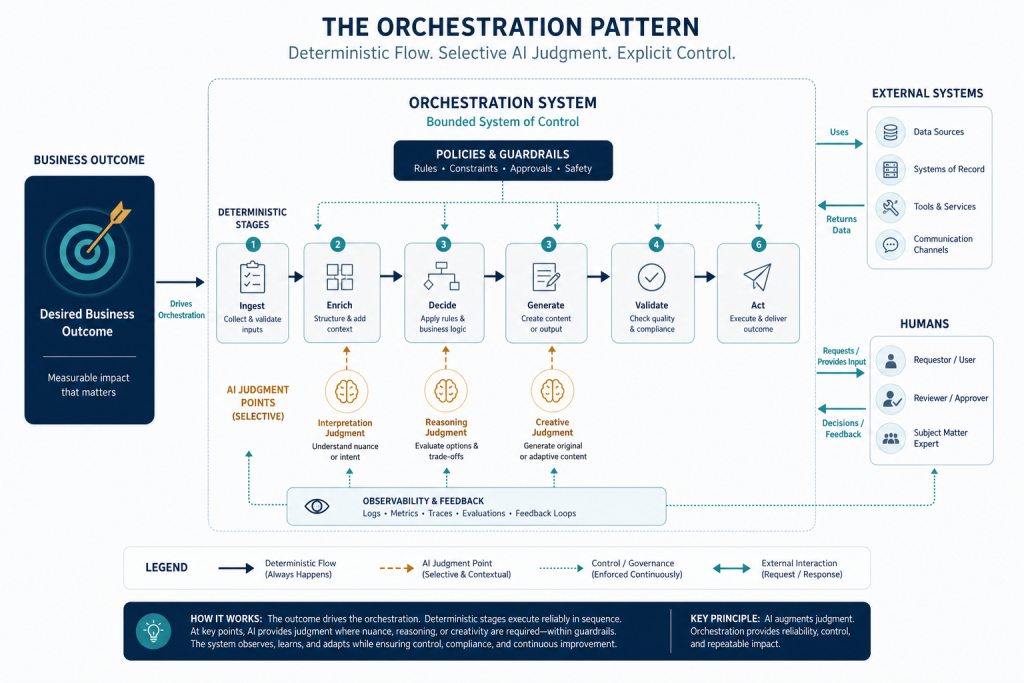
Establish precise architectural language and determine whether, where, and how agency belongs in a larger controlled process before selecting tools or frameworks.
Module objectives
- Classify five candidate designs using operational distinctions among deterministic workflows, AI-assisted workflows, bounded agents, agentic workflows, and multi-agent systems.
- Create an outcome and system-boundary specification that identifies actors, inputs, outputs, dependencies, exclusions, constraints, and measurable success criteria.
- Map each decision or action to deterministic logic, model judgment, a bounded agent, a tool, or a human and defend the minimum necessary level of agency.
- Produce a documented no-go or simplification decision when ordinary automation, an AI-assisted workflow, or one bounded agent is sufficient.
Detailed topic content is generated and researched separately so each topic maintains its own source trail.
This module in 6 slides
Click through for a quick overview, or use your arrow keys.
Put this module to work
Suggested time: 3 hours
Real-world scenario
An operations lead wants to automate new-client onboarding: collect documents, check them, set up accounts, schedule a kickoff call and send a welcome pack. Ten steps, two departments, three systems. Most of it is fixed. Two steps need judgment: deciding whether a document set is complete when clients send odd file types, and drafting a tailored welcome note. This module teaches you to see a process like that as a workflow with a few agentic steps inside it, not as one giant agent.
Step-by-step walkthrough
- Map the current process as a numbered list of steps, with who does each one today and which system it touches.
- Mark each step as fixed (same every time), language (read or write text) or judgment (decide what happens next).
- Group fixed steps into the deterministic backbone of the workflow. Place agentic steps only where judgment is needed.
- Write the opportunity case: time saved, error reduction, and the risks of automating each judgment step.
- Sketch the architecture: trigger, backbone, agent steps, approvals, and where results are stored.
Common mistakes and how to fix them

Most of the automation I run for my own course businesses looks exactly like this: a sturdy, boring backbone of fixed steps with one or two smart steps inside it. The boring parts are what make the smart parts safe. When something goes wrong, I want to know it was the one judgment step, not one of twenty.
Try this
Map a process you do every week. Count how many steps truly need judgment. Most people are surprised by how few there are.
Before you move on
Your checklist is saved in this browser.
Agent opportunity scorer
Rate your idea on five factors and get a recommendation: agent, plain workflow, or simplify first. Your work is saved in this browser.
Autonomy envelope builder
List the actions your agent might take and sort each into Do alone, Ask first or Never. Your work is saved in this browser.