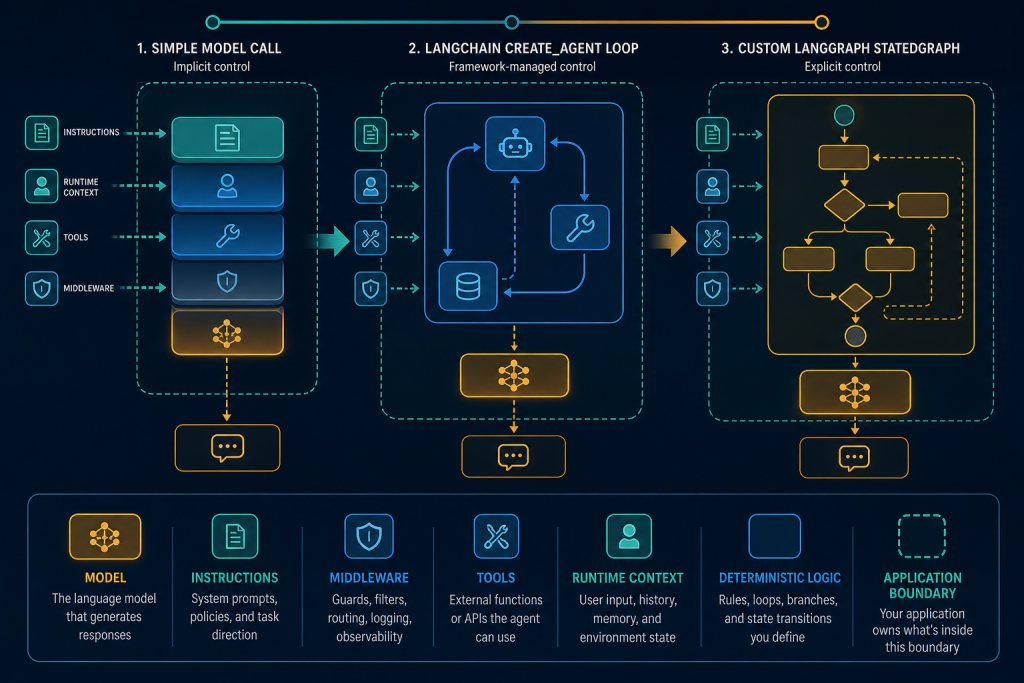
Establish a current, implementation-level mental model of LangChain agents, LangGraph orchestration, and project boundaries before learners introduce stateful complexity.
Module objectives
- Distinguish LangChain high-level agent APIs, LangGraph orchestration/runtime primitives, and LangSmith managed services.
- Implement a small bounded agent with current create_agent patterns and identify material Python/JavaScript differences.
- Allocate responsibility among the model, instructions, middleware, runtime context, tools, deterministic code, and surrounding application.
- Recognize when a direct model call or deterministic workflow is preferable to an agent loop.
Detailed topic content is generated and researched separately so each topic maintains its own source trail.
This module in 6 slides
Click through for a quick overview, or use your arrow keys.
Put this module to work
Suggested time: 3 to 4 hours
Real-world scenario
A team mixes old LangChain agent examples, new LangGraph code and LangSmith tracing without knowing which piece does what. Upgrades break things, and nobody can say whether a bug is in the chain, the graph or the tracing. This module sorts out the current roles: LangChain for models and building blocks, LangGraph for stateful control flow and LangSmith for tracing and evaluation, and when to use each.
Step-by-step walkthrough
- Install current versions and confirm them against the official documentation.
- Build a bounded agent using the current create_agent pattern with one tool and a clear system prompt.
- Turn on LangSmith tracing and inspect one run.
- Write down the agent’s boundaries: what it may do, what it must hand to code and what it must refuse.
- Identify any deterministic logic that should live outside the model.
Common mistakes and how to fix them

I have seen many projects get stuck on versions and old tutorials. My habit, from years of maintaining live systems, is to pin versions, read the current docs and turn on logging before writing anything clever. It saves days.
Try this
Find an older LangChain tutorial and list every API in it that the current docs have replaced.
Before you move on
Your checklist is saved in this browser.
Agent opportunity scorer
Rate your idea on five factors and get a recommendation: agent, plain workflow, or simplify first. Your work is saved in this browser.
Autonomy envelope builder
List the actions your agent might take and sort each into Do alone, Ask first or Never. Your work is saved in this browser.