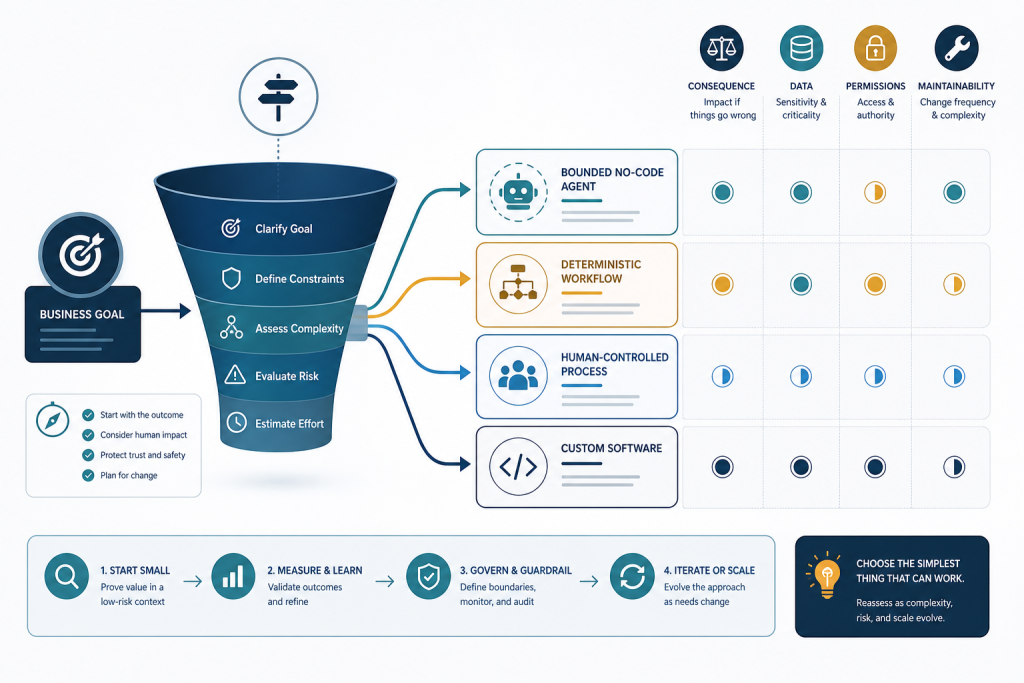
Select a viable, bounded no-code agent opportunity and an operationally appropriate implementation approach before opening a visual builder.
Module objectives
- Produce an opportunity brief that defines the user or business outcome, actors, inputs, outputs, integrations, consequence level, success measures, exclusions, and accountable owner.
- Classify proposed behavior as model-decided, deterministic, human-approved, or prohibited, and defend each classification using consequence and reversibility.
- Score at least three implementation approaches against documented operational criteria and recommend no-code, hybrid, conventional automation, or custom development with evidence.
Detailed topic content is generated and researched separately so each topic maintains its own source trail.
This module in 5 slides
Click through for a quick overview, or use your arrow keys.
Put this module to work
Suggested time: 2 to 3 hours
Real-world scenario
A real-estate agent wants an AI assistant that answers listing questions from website visitors at night. It is a great no-code candidate: one channel, a fixed set of listings, clear questions and a simple escalation (book a showing or call back in the morning). A request to automatically negotiate offers is not a good candidate, no matter which tool you use. This module helps you tell the difference before you spend a weekend building.
Step-by-step walkthrough
- List three automation ideas. For each, write the trigger, the input, the output and the risk if it goes wrong.
- Score each on frequency, clarity, risk and data availability.
- Pick the idea with high frequency, clear rules and low risk.
- Choose the tool that fits (Zapier, Make, n8n or a built-in assistant builder) based on the systems it must connect to.
- Run the no-code exit test: write down the signs that would mean you need custom code instead.
Common mistakes and how to fix them

I have built on both sides, no-code tools and full custom code, for my own businesses. No-code is the fastest way to prove an idea is worth it. Just be honest about the limits from the start, so you are not stuck rebuilding everything when the idea succeeds.
Try this
Write a one-paragraph pitch for your chosen agent idea to a business owner. If you cannot explain the value in one paragraph, pick a simpler idea.
Before you move on
Your checklist is saved in this browser.
Agent opportunity scorer
Rate your idea on five factors and get a recommendation: agent, plain workflow, or simplify first. Your work is saved in this browser.
Autonomy envelope builder
List the actions your agent might take and sort each into Do alone, Ask first or Never. Your work is saved in this browser.