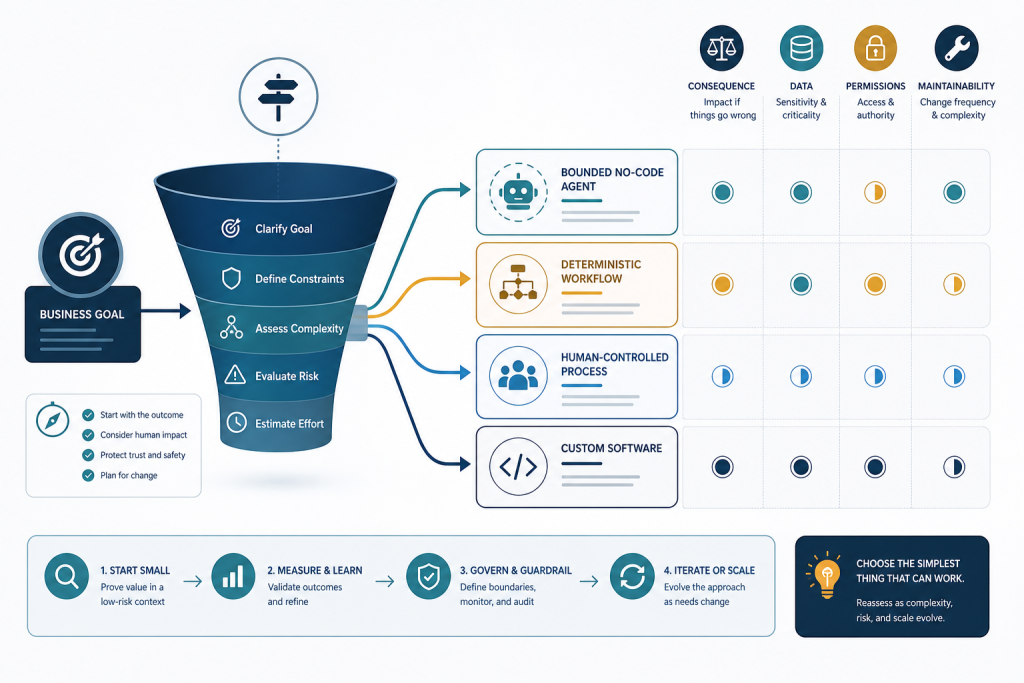
Why this matters: This lesson teaches you to select a no-code implementation mode with evidence rather than marketing assumptions. You will compare representative platforms at the exact tool, credential, trace, error, and governance level required by a bounded opportunity; then use a no-code exit test to decide whether a deterministic workflow, a visual agent, a hybrid architecture, or custom software is appropriate.
What you will be able to do
- Differentiate visual agent builders, deterministic automation, conversational builders, and hybrid visual/API approaches using an operational decision framework.
- Create a platform-neutral comparison matrix covering integration, APIs, credentials, data handling, observability, recovery, collaboration, cost, portability, and accessibility.
- Identify vendor-specific evidence about tools, authentication, execution visibility, testing, and error behavior without assuming parity across platforms.
- Apply a no-code exit test and defend a recommendation for no-code, deterministic automation, hybrid architecture, or custom software.
1. Frame the decision and separate the moving parts
Start with the failed workflow, not the platform menu. BrightPath’s prior flow was not unsafe because it used no-code. It was unsafe because a fuzzy model interpretation directly reached a consequential action: closing a help-desk case. The repair is architectural: treat an AI response as a proposed classification or draft, and let explicit workflow rules decide whether a write is permitted.
Your first artifact is an opportunity brief. Complete these fields before comparing builders:
- Bounded outcome: “Prepare a grounded draft reply and a recommended case label for benefits questions received through the approved form.”
- In scope: retrieval from the approved benefits library, drafting, and proposing one of four labels.
- Out of scope: benefits eligibility decisions, medical or legal advice, payroll changes, case closure, and outbound sending without review.
- Success evidence: a reviewer can see the source excerpt, proposed label, confidence rationale, and the exact input used.
- Failure impact: an inaccurate draft is recoverable; an unauthorized case update is not automatically acceptable.
That last distinction directs tool choice. If the job is “copy these approved fields to a system of record,” use deterministic automation. If the job requires interpreting unstructured text but its output can be reviewed before action, a bounded agent may help. “Agentic” is not a requirement; it is an implementation option.
2. Map the real architecture before judging a builder
Draw the proposed system as six distinct layers. Do not blur them together because each has a different control and retention question.
- Model instructions: stable rules such as “use only supplied policy excerpts; never state eligibility; return a draft plus label.” They guide the model but do not enforce external permissions.
- Transient input: the current employee question, case ID, and non-sensitive routing fields. Minimize this payload.
- Workflow/application state: deterministic fields carried through this run—request ID, retrieval status, approval status, retry count, and draft version.
- Grounded context: retrieved, approved policy passages with document title, version, and excerpt IDs. This is evidence for the answer, not free-form “memory.”
- Durable memory: a deliberately retained user or case preference/history record. Do not add it merely because a platform offers a memory feature; define purpose, owner, retention, and correction/deletion process first.
- Tools and deterministic logic: tools read or write external systems; workflow branches validate data, enforce approval, prevent duplicates, and stop unsafe runs.
Create a tool contract for every proposed integration: trigger/input, permitted operation, credential owner, exact permissions/scopes, data sent, expected response, timeout/rate-limit behavior, failure owner, and whether the action is reversible. If a platform offers a generic HTTP/API capability, it can expand coverage—but it also means someone must understand the destination API’s authentication, required fields, pagination, rate limits, and error responses. A visual interface does not make an undocumented API contract safe.
3. Build an evidence-based comparison matrix
Compare behaviors, not vendor labels. “Agent,” “AI,” “connection,” and “history” mean different things across products. Verify the exact feature in current official documentation and record the plan, deployment, and channel assumptions next to your decision.
| Representative mode | What current documentation confirms | Decision implication |
|---|---|---|
| n8n visual workflow / hybrid API | n8n supports generic OAuth credential configuration, execution views with filters and retry of failed workflows, and separate error workflows. Its workflow sharing documentation also warns that workflow editors can use credentials used by a shared workflow, even when those credentials were not explicitly shared. | Useful where API flexibility and self-hosting control matter, but credential-sharing design and execution-data retention must be actively governed. Do not share a production workflow casually. |
| Zapier AI by Zapier inside a Zap | An AI step can dynamically select configured app actions as tools. Per-tool approval can be required; run history shows model tier, tools used, actions, and success. Zapier states tool use and task consumption are dynamic, and its current guardrail pauses runs exceeding 75 tasks for review. | Good for a tightly bounded, connector-led workflow with explicit approval for writes. Estimate and monitor cost from actual task/tool-call history rather than assuming one run equals one unit of work. |
| Microsoft Copilot Studio conversational agent | Tools can use author or user authentication. Microsoft says user authentication is appropriate where access must be limited to the individual user; its documentation also describes test sets/evaluations, session transcripts, tool-use monitoring, and authentication-error review. | Strong fit when the experience belongs in a governed Microsoft environment and per-user access is essential. Confirm the intended publication channel supports the chosen authentication pattern. |
| Make scenario automation | Make documents execution history with module outputs and logs, error handlers, incomplete executions, and manual retry/resolution paths. It also documents that repeated unhandled errors can disable a scenario schedule. | Suitable for explicit integration scenarios, provided you build incomplete-execution handling and duplicate protection rather than treating retry as harmless. |
These examples are vendor-specific, not transferable claims. For example, an execution trace is useful only if it shows enough input, branch, tool, and response detail for your team to diagnose a wrong action—while still meeting your sensitive-data and retention rules. n8n allows configuration to save only error executions and documents default pruning settings in self-hosted configuration; that is a useful reminder that observability and data minimization must be designed together. ([github.com](https://github.com/n8n-io/n8n-docs/blob/main/docs/integrations/builtin/credentials/httprequest.md?utm_source=openai)) Zapier’s documented tool-activity trace and approval settings are specific to its AI-by-Zapier configuration. ([help.zapier.com](https://help.zapier.com/hc/en-us/articles/45863491098893-Add-tools-to-your-AI-by-Zapier-step?utm_source=openai)) Microsoft’s user-versus-author authentication distinction and monitoring/evaluation capabilities are likewise product-specific. ([learn.microsoft.com](https://learn.microsoft.com/en-us/microsoft-copilot-studio/configure-enduser-authentication?utm_source=openai)) Make’s history and incomplete-execution behavior are specific to Make scenarios. ([help.make.com](https://help.make.com/introduction-to-errors-and-warnings?AP=%3C%2Fkj&GET_PATH=%3C%2Fkj&IsFinance=%3C%2Fkj&TWOKITCHENS=%3C%2Fkj&TravelTypeId=%3C%2Fkj&TypeVB=%3C%2Fkj&admin_password=%3C%2Fkj&admin_users=%3C%2Fkj&aps=%3C%2Fkj&article=%3C%2Fkj&attachmentUploadDir=%3C%2Fkj&bah=%3C%2Fkj&bly=%3C%2Fkj&category_no=%3C%2Fkj&cntnt01display=%3C%2Fkj&codemirror=%3C%2Fkj&cpte=%3C%2Fkj&czm=%3C%2Fkj&dhcpfirst=%3C%2Fkj&dormitorios=%3C%2Fkj&ebs=%3C%2Fkj&eia=%3C%2Fkj&en.lproj=%3C%2Fkj&eprice=%3C%2Fkj&filebox-custom-design=%3C%2Fkj&filter.page=%3C%2Fkj&filter_4=%3C%2Fkj&fpub=%3C%2Fkj&gadgetCornerWeightNUM=%3C%2Fkj&gd_no=%3C%2Fkj&gitegroupe=%3C%2Fkj&issuesPage=%3C%2Fkj&journalCd=%3C%2Fkj&kahb=%3C%2Fkj&kat0=%3C%2Fkj&ley=%3C%2Fkj&llx=%3C%2Fkj&mjv=%3C%2Fkj&mm_end=%3C%2Fkj&mobi=%3C%2Fkj&news_idx=%3C%2Fkj&page_sel=%3C%2Fkj&passphrase=%3C%2Fkj&pgsqlcon=%3C%2Fkj&phpvarname=%3C%2Fkj&playlist=%3C%2Fkj&podcast_id=%3C%2Fkj&ps_boid=%3C%2Fkj&s_mcd=%3C%2Fkj&seoParameters=%3C%2Fkj&servicios=%3C%2Fkj&shname=%3C%2Fkj&snnr=%3C%2Fkj&suw=%3C%2Fkj&svff=%3C%2Fkj&swr=%3C%2Fkj&ted=%3C%2Fkj&translate=%3C%2Fkj&uniqueid=%3C%2Fkj&uzo=%3C%2Fkj&vuz=%3C%2Fkj&wx=%3C%2Fkj&xrn=%3C%2Fkj&utm_source=openai))
4. Run the no-code exit test
Score each candidate only after inspecting it against your brief. Use pass / conditional / fail, plus a note linking to the evidence you checked. Avoid a single weighted score that hides a security failure.
| Criterion | Question to answer | BrightPath requirement |
|---|---|---|
| Integration coverage and API flexibility | Can it retrieve approved documents and create a draft/update through supported, documented actions? | Read-only policy retrieval; draft-only help-desk update initially. |
| Authentication and permissions | Whose identity performs each call—employee, reviewer, service account, or maker? What is the least writable scope? | Separate read identity; reviewer-owned or narrowly scoped service identity for draft creation; no case-close scope. |
| Data handling | What prompt, attachment, execution, and trace data is stored? Where, for how long, and under which organizational controls? | Minimize employee data; record an approved retention decision before pilot. |
| Visibility and evaluation | Can an operator inspect retrieval evidence, branch choices, tool arguments, responses, and failed runs? Can test cases be repeated? | Yes; test set and trace review are release gates. |
| Recovery | Can you distinguish timeout/rate limit from malformed input or permission denial? Can retries duplicate a write? | Retry reads; never blindly retry case writes; check request ID before creating a draft. |
| Change control and collaboration | Can you identify the live version, review changes, restrict editors, and hand it off? | Named owner, documented release version, least-privilege builder access. |
| Cost and portability | What is billed: operations, tasks, model usage, tool calls, users, environments, or hosting? Can the workflow and data contracts be exported or rebuilt? | Forecast peak volume and exception volume; preserve a platform-neutral tool-contract document. |
| Accessibility and operator fit | Can reviewers and operators use the authoring, approval, and monitoring experience effectively with their required assistive technology and workflow? | Run an accessibility/usability check with the actual reviewers—not a claim based on a sales page. |
Portability rarely means “one-click migration.” It means you retain platform-neutral assets: the opportunity brief, state diagram, prompt/instruction version, retrieval schema, tool contracts, permission plan, test cases, and acceptance rubric. Those artifacts let another team rebuild the bounded system if the platform, pricing, connector, or governance fit changes.
5. Make the recommendation operational, not aspirational
Use this exit test before configuring production credentials. A “yes” does not mean failure; it means change the implementation recommendation.
- Choose deterministic automation instead of an agent when inputs are structured, business rules are known, and the desired action must be identical for identical inputs. Example: route a form based on department and region.
- Choose a hybrid visual/API design when the canvas handles orchestration well but the required service has a missing connector, a specialized API endpoint, pagination, custom OAuth scopes, idempotency headers, or a validation service. Keep the API call narrowly specified and wrap it with visual controls.
- Choose custom software or an engineering-owned service when you need complex per-user authorization across multiple systems, high-volume/concurrent processing, strict audit or residency requirements the platform cannot contractually/configurationally meet, advanced test/release pipelines, long-running stateful work, bespoke user interfaces, or predictable low unit cost at scale.
- Do not launch yet when you cannot answer: what data is sent to the model/tool, which identity acts, how a write is prevented from duplicating, where a human can inspect a trace, how an error reaches an owner, and how an urgent stop occurs.
For BrightPath, recommend a hybrid, review-first pilot: a visual workflow receives the form, validates required fields, retrieves only approved policy excerpts, asks the model for a structured draft/label/citation bundle, and creates a draft help-desk note under a narrowly scoped identity. A reviewer—not the model—sends the response or changes case status. This is stronger than a fully autonomous conversational agent because uncertainty in policy interpretation is contained before any employee-facing or case-final action.
Decision Lab: Select a Safe Implementation Mode for BrightPath Benefits
Scenario: Fictional scenario using synthetic data: BrightPath Benefits receives 80–250 employee benefits questions each weekday. The People Operations team proposes an agent that reads a shared intake form, consults approved benefits PDFs, drafts an answer, and—when appropriate—updates a case in the HR help-desk system. A previous automation failed when a connector’s shared administrator credential closed two cases that merely mentioned the word “resolved.” The team needs a safe recommendation before building.
Create a four-option recommendation pack for the fictional BrightPath scenario: (1) deterministic scenario, (2) connector-led AI workflow, (3) conversational agent, and (4) hybrid visual/API workflow. Use synthetic questions and invented case IDs only. Deliverables: a one-page opportunity brief; the six-layer architecture map; a comparison matrix marked pass/conditional/fail with an official-documentation evidence note for every claimed capability; three tool contracts (policy retrieval, draft-note creation, notification); a credential/permission map; an approval and fallback tree; a 12-case test set; and a one-paragraph recommendation. In your test set include: ordinary policy question, missing case ID, conflicting policy excerpts, prompt injection in the user text, expired credential, rate limit, connector timeout, duplicate submission, model output with no evidence ID, prohibited eligibility question, reviewer rejection, and a simulated stop-the-line incident. Add all finalized artifacts to your No-Code AI Agent Build Portfolio as “Module 1—Opportunity and Exit Decision.”
Self-review checklist
- I wrote a one-sentence bounded outcome and excluded decisions the system must not make.
- I separated model instructions, transient input, workflow state, grounded documents, tool calls, and durable records.
- I inspected each proposed connector/action and identified the identity and scope under which it runs.
- I placed a deterministic validation and approval gate before every consequential external write.
- I defined an idempotency key or duplicate-action check for every retryable write action (for example, case update or message send).`,`I specified stop conditions, retryable versus non-retryable failures, and a human escalation destination.`,
Module capstone: apply the module in the AI Agentic School Decision Lab below. Mastery unlocks the LearnDash completion control for this topic.
AI Agentic School Decision Lab
Please sign in to submit your module decision and receive feedback.
Key takeaways
- Choose an implementation mode by the risk, reversibility, integration, and operating requirements of the job—not by whether a canvas looks easy to use.
- Keep deterministic workflow logic in charge of triggers, validation, approvals, duplicate prevention, and final writes. Give AI bounded interpretation or drafting work.
- A connector is not proof that a platform is suitable: inspect the precise action, authentication identity, writable scope, execution trace, retry behavior, retention, and cost unit.
- The no-code exit test is a decision gate: recommend deterministic automation, hybrid visual/API design, or custom software when the visual solution cannot meet required controls reliably.
Useful terms
- Agentic step
- A model-driven workflow step that can choose among configured tools or actions at runtime. Its discretion must be limited by tool permissions, structured outputs, and workflow gates.
- Connector
- A prebuilt integration between a platform and another service. Its available actions, fields, authentication behavior, and limits are specific to that connector and can change.
- Credential
- The authentication material or connection configuration that lets a workflow call another system. It represents an identity and its permissions, not merely a technical setup detail.
- Idempotency
- A property that makes repeating a request safe: the intended business result occurs once even if the system retries after a timeout or uncertain response.
Research & review note
This lesson is built from source-traceable research and reviewed before publication. AI Agentic School uses AI as a research and practice tool, not as a substitute for evidence or editorial judgment.