Determine whether an agent is justified and define a useful, testable, and appropriately bounded opportunity before selecting models, tools, or platforms.
Module objectives
- Compare prompts, assistants, deterministic workflows, automations, tool-using agents, and broader agentic systems using observable system characteristics.
- Write a goal specification with actors, inputs, outputs, constraints, assumptions, and evidence of successful completion.
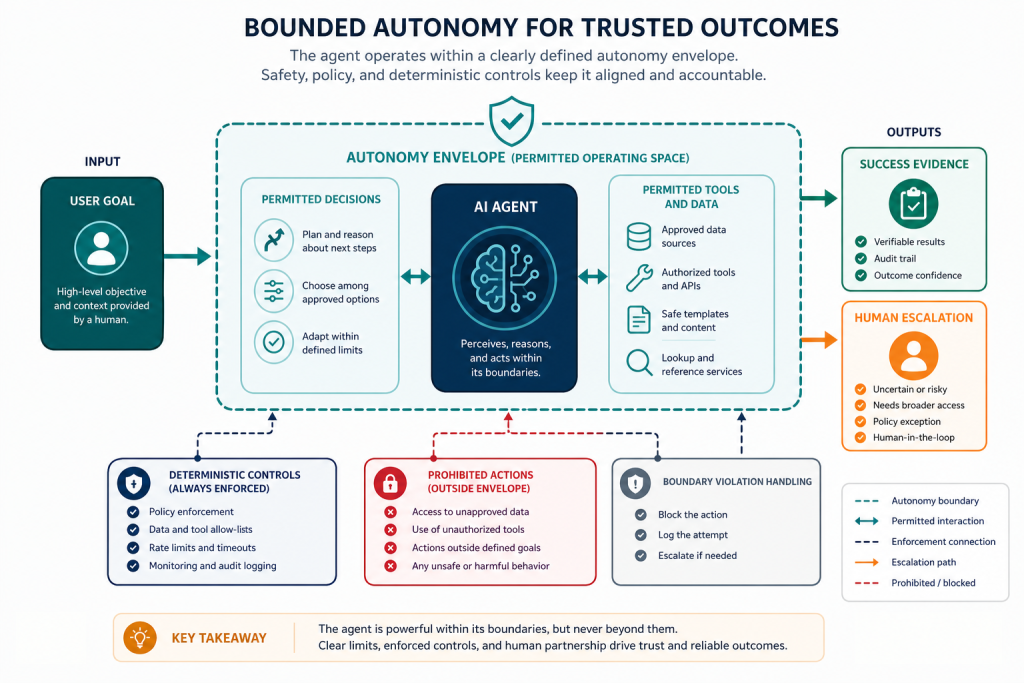
- Define an autonomy envelope that separates model-selected choices, deterministic rules, permitted actions, confirmation-required actions, and prohibited actions.
- Reject or simplify an agent proposal when variability, risk, economics, or task structure makes a less autonomous design preferable.
Detailed topic content is generated and researched separately so each topic maintains its own source trail.
This module in 6 slides
Click through for a quick overview, or use your arrow keys.
Put this module to work
Suggested time: 2 to 3 hours
Real-world scenario
A marketing manager asks for an AI agent that runs our social media. That is not an agent spec; it is a job description. In this module you turn requests like that into something buildable: a specific task, a clear finish line and an autonomy envelope that says what the agent may do on its own, what needs a person’s OK, and what it must never touch.
Step-by-step walkthrough
- Take a broad request and break it into separate tasks. Pick one task that repeats often and has a clear finish line.
- Write the goal in one sentence, plus what evidence would prove the task is done.
- Draw the autonomy envelope: do alone, ask first, never.
- Check whether a simple prompt or a fixed workflow would already solve it. Only continue if real judgment is needed.
- Write three examples of success and three of failure for this task.
Common mistakes and how to fix them

I have built websites and systems for more than 25 years, and every successful project started with a narrow first version. The same is true of the AI work I do on my own course sites and on Project Incarnate. Start with one task you can measure, get it reliable, then grow it.
Try this
Rewrite a vague request from your own work (we need AI for customer service) into one task with a goal, completion evidence and an autonomy envelope.
Before you move on
Your checklist is saved in this browser.
Agent opportunity scorer
Rate your idea on five factors and get a recommendation: agent, plain workflow, or simplify first. Your work is saved in this browser.
Autonomy envelope builder
List the actions your agent might take and sort each into Do alone, Ask first or Never. Your work is saved in this browser.