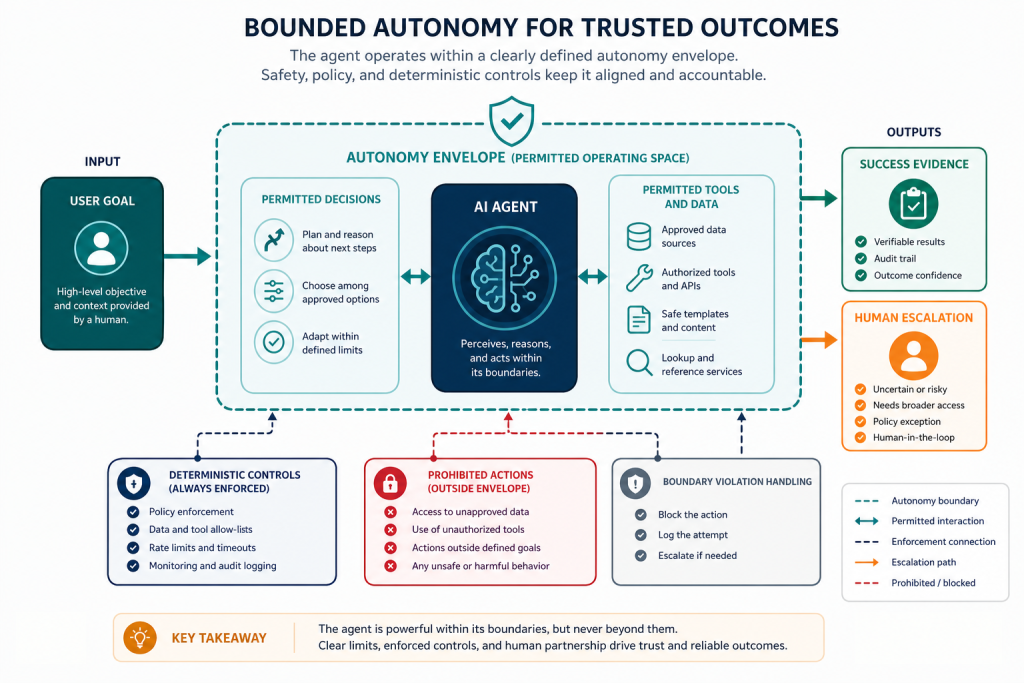
Why this matters: A useful autonomy boundary separates what a model may interpret or recommend from what deterministic application logic must enforce and what a human must own. This lesson gives learners a practical method to reject unjustified agent designs, select a simpler architecture where appropriate, and document a bounded agent opportunity when variable judgment truly adds value.
What you will be able to do
- Classify proposed system decisions into deterministic, model-assisted, bounded agent-selected, human-owned, and prohibited categories.
- Draw an autonomy envelope using consequence severity, reversibility, permissions, confirmations, verification, and escalation rules.
- Defend an agent-versus-simpler-system choice using a representative evaluation plan and explicit operational tradeoffs.
- Produce a control specification that separates context, state, history, memory, grounded knowledge, model proposals, and tool execution.
1. Start by challenging the autonomy claim
Constrained brief: The operations director says: “Let the model read supplier notices, decide what changes, update our ERP, and notify customers. We need it autonomous because the inbox is messy.” That last sentence is not a requirement; it is a hypothesis. The inbox may be variable, but changing a price is a controlled business operation with contractual, financial, and customer consequences.
Your first design move is not choosing a model or an agent framework. It is to turn the proposal into a decision inventory. List every decision hidden inside “handle a notice”:
- Is this message authentic and in scope?
- Which supplier, SKU, effective date, currency, and price does it refer to?
- Does the proposed change violate a contract, margin rule, or approval limit?
- Should the ERP record be changed now, scheduled, or rejected?
- Which customers, if any, should be notified?
- Who is accountable if the notice is ambiguous or incorrect?
Only some of those require flexible language interpretation. Others require rules, authoritative records, permissions, and accountable business judgment. NIST’s AI RMF emphasizes documenting system objectives, assumptions, context, and lifecycle evaluation; it also calls for roles and responsibilities in human–AI configurations to be clearly differentiated. ([airc.nist.gov](https://airc.nist.gov/airmf-resources/airmf/5-sec-core/?utm_source=openai))
Working distinction: a prompt generates text from supplied context. A retrieval assistant finds grounded material and helps a person interpret it. A simple automation follows predeclared rules and routes data. A deterministic workflow applies defined conditions and invokes fixed integrations. A bounded agent may select among a limited set of next steps to advance a goal under changing conditions, but it does not get authority merely because it selected a step. The application still validates, authorizes, executes, records, and verifies actions.
For this brief, “extract structured fields from a notice and queue a review” may need model capability. “Write a new price to ERP” does not become an agent decision simply because the model can request the write.
2. Separate interpretation, control, and execution
Create a one-page Agent Opportunity Brief before designing prompts or tools. It should force a decision rather than market an idea.
| Field | Example for supplier notices |
| Operational goal | Reduce manual triage time while preserving correct, authorized price records. |
| Unit of work | One inbound supplier notice and its linked ERP records. |
| Variability that may justify a model | Different email formats, attached PDFs, ambiguous wording, multiple languages. |
| Deterministic truth sources | Supplier master, contracts, SKU catalog, approval matrix, current ERP price. |
| Potential benefit | Faster extraction, classification, evidence assembly, and routing. |
| Material harms | Incorrect price, premature effective date, disclosure to wrong customer, lost auditability. |
| Named accountable owner | Pricing manager, not “the AI team.” |
| Success evidence | Representative notices show that extraction and routing reduce review effort without increasing unauthorized or incorrect changes. |
Then classify each decision using five lanes:
- Deterministic: identity matching, contract thresholds, allowed date formats, user access, duplicate detection, retention, logging, and tool argument validation.
- Model-assisted: extract fields, identify ambiguity, summarize the notice, propose a queue and rationale.
- Agent-selected within a boundary: choose whether to ask for a missing attachment, retrieve a relevant contract, or route to pricing versus procurement.
- Human-owned: approve exceptions, resolve contradictory evidence, accept high-impact commercial terms, and decide policy changes.
- Prohibited: altering approval limits, bypassing authentication, sending price notices externally without the required approval, or making changes from untrusted instructions embedded in an email.
Do not place deterministic policy inside a natural-language instruction and hope the model follows it. Encode it in application logic. The model can return a typed proposal such as candidate_supplier_id, proposed_effective_date, evidence_spans, ambiguity_flags, recommended_route. A validator checks types, source provenance, current permissions, contract rules, and conflict conditions. Only then can a workflow create a draft, request approval, or execute an allowed tool.
3. Build the autonomy envelope and approval gates
Draw the autonomy envelope around a specific action, not around the entire system. Autonomy should contract as consequence severity, uncertainty, or irreversibility increases.
Use two independent ratings for each action:
- Consequence severity: What is the plausible financial, safety, legal, privacy, customer, or operational impact if wrong?
- Reversibility: Can the exact effect be reliably undone after downstream systems and people have reacted? A database field may be technically editable, yet an emailed price change may already be commercially consequential.
Low-severity, reversible work can often be automatic: classify a notice, create a non-binding internal draft, or fetch an approved contract. Moderate-impact work may be agent-proposed but require deterministic checks and a reviewer: stage a price change that meets known conditions. High-impact or hard-to-reverse work should require explicit approval or remain prohibited: publish customer communications, change contractual pricing, issue refunds, delete records, alter permissions, or execute a payment.
Permissions are not tool names. “ERP update” is too broad. Scope permission to the minimum resource and operation: create a draft price record for a named supplier and SKU; never update contracts; never alter approval rules; no writes outside a specified business unit. OWASP’s AI Agent Security guidance recommends minimum necessary tools, per-tool read/write and resource scoping, explicit authorization for sensitive operations, and structured security testing after material changes to prompts, tools, memory, retrieval, policy, or model provider. ([cheatsheetseries.owasp.org](https://cheatsheetseries.owasp.org/cheatsheets/AI_Agent_Security_Cheat_Sheet.html?utm_source=openai))
A confirmation gate needs an information packet. Before asking a pricing manager to approve, show: proposed change, old and new values, effective date, contract clause or source excerpts, confidence is not sufficient on its own, detected conflicts, customer impact, and the exact tool action to be executed. Give the reviewer approve, reject, edit, or escalate options. Set expiry and timeout behavior: no response means the draft remains unexecuted. This is fail closed.
Approval must occur before side effects. Current OpenAI Agents SDK documentation, for example, describes a pattern in which a sensitive tool call interrupts a run, surfaces the parsed arguments for approval or rejection, and resumes only after the decision; malformed arguments require manual approval rather than silently continuing. That is an implementation-specific example of the durable rule: validate and authorize before execution. ([openai.github.io](https://openai.github.io/openai-agents-python/human_in_the_loop/?utm_source=openai))
4. Make the case for the simplest adequate system
Now make the hard product decision: should this be an agent? Use a comparison matrix with representative work, not a demo.
| Architecture | Use when | Supplier-notice choice |
| Prompt or drafting feature | A person provides all context and retains all decisions. | Useful for summarizing a notice; no system action. |
| Retrieval assistant | The main uncertainty is locating and explaining approved knowledge. | Useful for showing a buyer the relevant contract and policy. |
| Deterministic workflow | Inputs are structured or can be normalized; rules and routes are stable. | Best for known supplier templates and rule-compliant changes. |
| Simple automation plus model extraction | Language varies, but the subsequent route is fixed. | Strong default: extract to schema, validate, then create a review task. |
| Bounded agent | Cases require choosing among limited investigative or routing steps, with clear stop and escalation rules. | Potentially justified for ambiguous notices that require targeted retrieval and follow-up. |
The initial recommendation is not an autonomous price-changing agent. Build a model-assisted intake and deterministic review workflow first. It handles the actual variability—unstructured notices—without giving a probabilistic component direct authority over a commercial record. Add a bounded agent only if evidence shows that a fixed route creates repeated, costly dead ends and the permissible next-step choices can be enumerated, logged, and safely stopped.
Evidence is comparative: sample real historical notices after appropriate privacy review; label the correct fields, route, exceptions, and required human decision; run the same set through the simpler design and agent candidate. Measure extraction validity, correct routing, unsupported claims, escalation quality, reviewer time, end-to-end latency, tool failures, and every attempted policy violation. Also count operational costs: tool integrations, monitoring, incident response, prompt/model change testing, and reviewer workload. NIST frames testing, evaluation, verification, and validation as evidence that systems meet goals while minimizing negative impacts, and calls for documented test sets, metrics, and tools. ([nist.gov](https://www.nist.gov/artificial-intelligence/ai-research/tevv-athlon-framework-evaluating-ai-systems?utm_source=openai))
An agent loses the decision if its incremental benefit does not outweigh its added attack surface, nondeterminism, latency, observability burden, and maintenance. “It seems more intelligent” is not evidence.
5. Specify failure recovery, evidence, and governance
If the bounded-agent option survives comparison, write its control specification. Keep four kinds of information distinct:
- Task context: the current notice, requester identity, permitted goal, and deadline.
- Application state: workflow status, approvals, retries, idempotency key, tool results, and current action budget.
- Conversation history: prior turns needed to resolve this case; summarize or limit it rather than treating it as authoritative truth.
- Durable memory and grounded knowledge: durable preferences only when justified and governed; supplier master, contracts, and policy documents retrieved from authoritative systems for this decision.
Do not let an email instruct the system to override the contract, reveal a credential, or make unrelated tool calls. Treat external content as data, not instruction. The agent receives only the read tools necessary for its stage, a maximum number of tool calls, an allowlisted set of routes, and a stop condition. Example: stop after two failed identity-resolution attempts, conflicting contract evidence, missing effective date, or any write request. Escalate with an evidence packet rather than guessing.
For every write that remains allowed after approval, use an action-verification loop: validate the approved arguments again; execute with an idempotency key; read back the committed ERP record; compare committed values to the approved proposal; record actor, source evidence, approval ID, tool response, and timestamp; notify the owner if verification fails. A tool call proposed by a model is not proof that the action occurred correctly.
Release only when the representative test set passes predeclared thresholds chosen by the business owner, all prohibited-action tests fail safely, approval bypass tests fail, traces make each action reconstructable, accessibility needs are met in the reviewer interface, and an incident owner can pause the system. Monitor drift in notice formats, escalation rate, validation failures, approval reversals, tool error rate, latency, and attempted out-of-bound actions. Re-test after any material change to model, instructions, schema, tools, retrieval corpus, or policies.
Applied Practice: Reject or Bound the Procurement Agent
Scenario: Fictional scenario using synthetic data: You are advising a 70-person distributor that receives supplier price-change notices by email. Operations proposes an “autonomous procurement agent” that reads notices, changes purchase prices in the ERP, and emails customers about resulting price changes. Your job is to determine whether this should be an agent at all, then draw its permitted autonomy envelope.
Create a portfolio-ready Decision Lab packet for the fictional supplier-notice scenario. Deliverable 1: a one-page Agent Opportunity Brief. Deliverable 2: an autonomy-envelope table covering at least 12 decisions, with lane, severity, reversibility, permission, confirmation, verification, stop condition, and human owner. Deliverable 3: an architecture comparison of retrieval assistant, model-extraction workflow, and bounded agent, with a recommendation and three tradeoffs. Deliverable 4: a test set plan containing 20 synthetic notices, including duplicate notices, missing dates, conflicting contract clauses, malicious text in an attachment, an unsupported supplier, and a valid low-risk change. Deliverable 5: a stakeholder defense: explain to the pricing manager why your chosen system is safer and what evidence would justify expanding or reducing autonomy. Add the final packet to your AI Agent Build Portfolio as “Module 1 — Autonomy Envelope Decision.”
Self-review checklist
- I named the operational goal, accountable human owner, affected parties, and unacceptable outcomes.
- I classified each proposed decision as deterministic, model-assisted, agent-selected, human-approved, or prohibited.
- I separated a model’s proposed action from deterministic authorization and actual tool execution.
- I assigned every action a consequence level, reversibility rating, permission tier, verification method, and stop condition.
- I documented why a prompt, retrieval assistant, automation, or deterministic workflow was rejected or selected instead of an agent by using representative-case evidence rather than enthusiasm alone.
Module capstone: apply the module in the AI Agentic School Decision Lab below. Mastery unlocks the LearnDash completion control for this topic.
AI Agentic School Decision Lab
Please sign in to submit your module decision and receive feedback.
Key takeaways
- An agent is justified when the task needs bounded judgment across variable cases; it is not justified merely because an LLM can produce an answer.
- Keep eligibility, authorization, policy thresholds, data access, execution, and audit logging deterministic and application-controlled.
- Increase autonomy only when an action is low-consequence, reversible, observable, and recoverable—and reduce it when uncertainty, external impact, or irreversibility rises.
- Treat human approval as a designed control with a clear owner, decision packet, timeout, and fail-closed outcome—not as a vague promise of “human in the loop.”
- Compare an agent against simpler alternatives using representative work, error costs, operational burden, latency, and maintenance evidence before building.
Useful terms
- Autonomy envelope
- The explicit set of goals, choices, tools, resources, action limits, permissions, confirmation gates, stop conditions, and escalation paths within which an agent may operate.
- Deterministic control
- Application logic that produces a defined result from specified inputs, such as authorization checks, thresholds, schemas, and idempotency handling.
- Idempotency key
- A unique execution identifier used so a retried write request does not create the same side effect more than once.
- Least privilege
- Granting only the minimum data access, tool capability, operation type, and resource scope required for a task.
Research & review note
This lesson is built from source-traceable research and reviewed before publication. AI Agentic School uses AI as a research and practice tool, not as a substitute for evidence or editorial judgment.