Why this matters: A rigorous intake practice prevents teams from treating every language task as an agent opportunity. This lesson gives cross-functional teams a shared decision standard for selecting among prompts, assistants, deterministic workflows, conventional automation, tool-using agents, broader agentic systems, and no-build/process alternatives. Learners use consequence, uncertainty, reversibility, and verification cost to defend a pattern decision and add it to their AI Agent Team Operating Playbook.
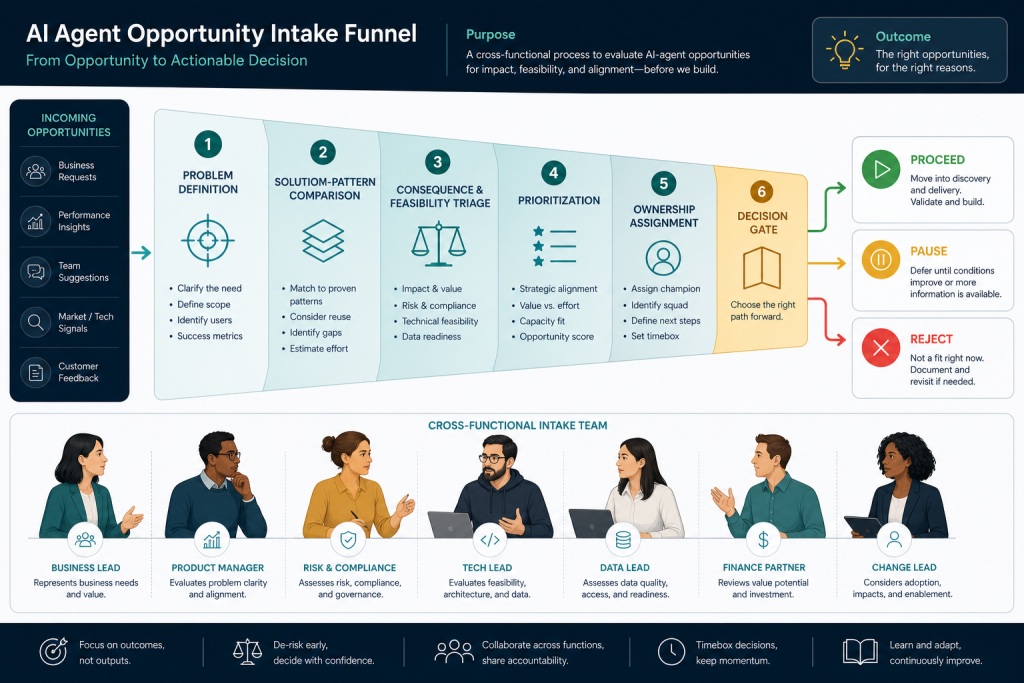
What you will be able to do
- Distinguish operational implications of prompts, assistants, deterministic workflows, conventional automation, tool-using agents, and broader agentic systems.
- Assess whether variability, uncertainty, multi-step adaptation, and external actions create a justified need for adaptive agent behavior.
- Use reversibility, action consequence, privilege, and verification cost to set an appropriate autonomy and review level.
- Create a Pattern Decision Record with an owner, candidate alternatives, permission boundaries, evaluation evidence, and release conditions.
Why a repeatable suitability decision is needed
The meeting that should have happened before the pilot
Fictional scenario. On a Friday afternoon, Revenue Operations asks for an “AI renewal agent.” The proposal says it will read customer emails, detect churn risk, update CRM fields, generate retention offers, and send those offers. Sales wants a pilot in two weeks. Security asks which systems it can change; Finance asks who approves discounts; account executives ask whether they will now need to check every message; engineering asks why a workflow will not do.
The request sounds like one initiative, but it contains at least five different tasks with different uncertainty, consequences, permissions, and verification needs. In a previous chatbot rollout, inconsistent CRM updates created duplicate follow-ups. The immediate operating gap is not a lack of model capability. It is the absence of a shared method for deciding when adaptive behavior is justified and when a simpler pattern is safer, cheaper, and more maintainable.
This lesson establishes that method. Its purpose is to make “no agent,” “not yet,” and “use a workflow instead” legitimate, evidence-based outcomes rather than signs that a team lacks ambition.
Pattern selection is a team control, not an architecture preference
Teams often collapse several solution patterns into the word agent. That creates avoidable review failures. A prompt can help a person draft text. An assistant can interpret information and propose an answer. A deterministic workflow can execute known steps. Conventional automation can move structured data across systems. A tool-using agent can select among permitted tools and adapt a bounded sequence. A broader agentic system can coordinate multiple components over longer-running work.
These patterns differ operationally. Each added layer of adaptation can increase flexibility, but it can also increase test surface, latency, operating cost, failure modes, monitoring needs, security exposure, and reviewer burden. The default is therefore the least complex pattern that achieves the outcome with acceptable quality and control.
Working distinctions
- Prompt: a person uses a model for one bounded task; the person retains judgment and action.
- Assistant: a model helps interpret, summarize, retrieve, or draft; it may be embedded in a work surface but does not independently take consequential action.
- Deterministic workflow: a predefined sequence with explicit branching, validation, and ownership.
- Conventional automation: rules, integrations, scripts, or RPA execute structured and specified actions.
- Tool-using agent: a model selects from constrained tools and adjusts next steps based on results, within a defined task boundary.
- Broader agentic system: multiple adaptive components, potentially with delegation or persistent planning, coordinate work across a larger objective.
These are useful operating categories, not rigid technical definitions. A workflow can include an LLM classification step. An assistant can call a read-only search function. The review question is always: what is allowed to vary, what can act externally, and what prevents or contains a bad result?
The decision standard: uncertainty, consequence, reversibility, verification
The core test: is adaptation truly necessary?
Use adaptive agent behavior only when all or most of these conditions are true:
- The path cannot be reliably enumerated in advance because relevant context changes across cases.
- The system must choose among bounded tools or next steps based on intermediate results.
- The task benefits from interpreting unstructured material, reconciling ambiguity, or recovering from expected exceptions.
- A deterministic rule set would be disproportionately brittle or expensive to maintain.
- The organization can verify important outputs and actions at a cost that is acceptable relative to the benefit.
Conversely, avoid an agent when the inputs, rules, path, and outputs are stable enough to specify. A workflow engine, integration, spreadsheet control, search interface, template, or a human process redesign will often be cheaper to test, faster to run, easier to maintain, and easier to audit. The decision is not “can a model do it?” It is “what is the least complex system that meets the outcome with acceptable quality and control?”
Four factors that change the pattern decision
1. Environmental uncertainty. Uncertainty is useful only when it is material. A support request that comes in many writing styles may justify an assistant that summarizes and drafts. It does not automatically justify a system that independently changes a contract, issues a refund, or closes a case. First ask whether retrieval, structured intake fields, or a routing rule removes enough uncertainty.
2. Action consequence and permissions. Separate reasoning from execution. An assistant may recommend a CRM update; a conventional automation may execute a validated update; a tool-using agent may select the correct record and proposed update; a human or downstream policy check can authorize the final write. OWASP identifies excessive functionality, permissions, and autonomy as key causes of excessive agency risk. Its practical implication for intake is to grant only the functions, scope, and identity needed for the approved task—not a broad account “because the agent might need it.” ([owasp.org](https://owasp.org/www-project-top-10-for-large-language-model-applications/2_0_vulns/LLM06_ExcessiveAgency.html?utm_source=openai))
3. Reversibility. A reversible action is not harmless, but it changes the control design. Creating a reversible draft in a queue can permit a lower-friction pilot than sending a customer message, deleting a record, changing a price, or initiating a payment. Record the rollback owner, time window, audit trail, and any downstream effects. If a correction itself is costly or uncertain, treat the action as effectively irreversible.
4. Verification cost. An output that takes a manager five seconds to confirm can support a human-in-the-loop pattern. A recommendation that requires an hour of subject-matter research to validate may not create real capacity; it may simply move work from production to review. Intake must estimate who verifies, how long it takes, what evidence they use, and what happens when they disagree. A model’s fluent explanation is not verification.
Choose the minimum viable pattern
A practical solution-pattern decision tree
Start with the business outcome and current process—not an AI label. Ask whether a non-AI fix resolves the bottleneck: clearer ownership, a form, a data-quality repair, a system integration, or a deterministic rule. If yes, choose that and retain the evidence. If language understanding or generation is needed, ask whether the task is single-turn and non-actioning. If so, use a prompt or assistant with bounded source material.
If the process has known steps, known exceptions, and structured validations, choose a deterministic workflow or conventional automation. Add an LLM only at the bounded interpretation step—for example, classify an incoming free-text request into one of approved queues, with confidence thresholds and a manual fallback.
Consider a tool-using agent only when the system must select among a small, allowlisted set of tools, adapt its sequence after observing tool results, and operate within explicit stopping conditions. Consider a broader agentic system only when coordination or persistent planning across multiple specialized components produces evidence-backed value that simpler orchestration cannot. “Multiple agents” is an architecture choice requiring a specific coordination benefit; it is not an upgrade path by default.
What to standardize—and what not to
Standardize the questions, evidence fields, decision roles, and review gates. Every intake should use the same definitions for outcome, action, permission, human checkpoint, test case, fallback, and accountable owner. This makes comparisons possible across teams and makes later incidents traceable: reviewers can see what was assumed, approved, and tested.
Do not standardize a universal answer such as “all agents require human approval” or “all read-only agents are low risk.” A read-only system may handle highly sensitive information; a write action may be low consequence if it is reversible and tightly scoped. Approval thresholds, data classifications, retention, vendor restrictions, and release authorities are organization-specific policies that should be set with the appropriate security, privacy, legal, risk, and business stakeholders. NIST’s framework is voluntary guidance, not a universal compliance checklist; it emphasizes documented risk management, task definition, evaluation, and lifecycle practices. ([nist.gov](https://www.nist.gov/publications/artificial-intelligence-risk-management-framework-ai-rmf-10?utm_source=openai))
Avoid process theater: an intake form that merely assigns “medium risk” without showing the action, affected system, permission, likely error, verification method, and owner does not enable a decision. Require just enough evidence to decide the next gate. A limited read-only prototype may need a small representative test set and a data-access review; an action-taking pilot needs explicit permission boundaries, approval logic, rollback, monitoring, and an incident route.
Make the decision reviewable and operable
Intake artifact: the Pattern Decision Record
Add the following one-page artifact to the team operating playbook:
| Field | Required decision evidence |
|---|---|
| Outcome and baseline | User outcome, current cycle time/error/rework evidence, and named outcome owner |
| Proposed task boundary | Inputs, output, excluded decisions, systems touched, and failure fallback |
| Candidate patterns | At least one simpler option and one no-build/process option considered |
| Adaptation evidence | Examples of uncertain paths or exceptions that rules cannot reasonably handle |
| Action and permission matrix | Read/write/delete/send/financial actions; data scope; identity; approval point |
| Consequence and reversibility | Worst credible failure, affected party, rollback feasibility, and rollback owner |
| Verification plan | Verifier role, acceptance rubric, sampling, escalation, and expected workload |
| Evaluation and release gate | Representative test cases, success/failure thresholds, logging, and stop conditions |
The record should explicitly capture assumptions. For example: “The agent will only produce a proposed CRM update; the CRM workflow performs required-field validation; account executives approve writes.” That is materially different from “the agent manages renewals.”
Evaluation, monitoring, and ownership follow the selected pattern
Pattern selection determines the evidence burden. For a drafting assistant, evaluate factual grounding, style, completeness, and reviewer time. For a deterministic workflow with an LLM classification step, test routing accuracy by class, abstention behavior, and failure routing. For a tool-using agent, additionally test tool selection, authorization boundaries, stopping behavior, duplicate-action prevention, recovery from missing data, and behavior when untrusted content attempts to redirect the task.
NIST notes that generative-AI use can warrant additional human review, tracking, documentation, and management oversight, while its AI RMF emphasizes objective, repeatable evaluation and documented results. Those are durable governance principles; the precise metrics, sample sizes, and approval roles are context-dependent organizational choices. ([nvlpubs.nist.gov](https://nvlpubs.nist.gov/nistpubs/ai/NIST.AI.600-1.pdf?utm_source=openai))
Monitoring must match the risk. Capture enough information to reconstruct material actions: task/run identifier, tool invoked, authorization context, inputs and outputs subject to data-handling policy, approval or rejection, result, errors, and rollback. Do not treat observability as a reason to collect sensitive content indiscriminately. For example, OpenAI’s Agents SDK documents tracing of model generations, tool calls, handoffs, guardrails, and custom events, while also documenting tracing configuration and sensitive-data considerations; teams must assess vendor-specific data behavior and configure it according to their own approved handling rules. ([openai.github.io](https://openai.github.io/openai-agents-python/tracing/?utm_source=openai))
Assign four distinct accountabilities where practical: a business outcome owner accepts the value and residual operational risk; a system owner maintains the implementation and controls; a data/security owner approves access and handling within organizational policy; and a review owner owns evaluation, release evidence, and periodic reassessment. One person may hold more than one role in a small team, but the accountabilities should not disappear.
Worked decision: decompose before you automate
Applying the standard to the renewal proposal
The proposed renewal agent combines variable language interpretation with consequential external actions: CRM changes and customer offers. The team should decompose it. An initial pattern may be: an assistant summarizes renewal signals and drafts a retention recommendation; a deterministic workflow retrieves account facts and enforces eligibility; an account executive approves any CRM update or customer communication. This preserves the benefits of language interpretation without granting broad autonomous authority.
The team may later test whether bounded tool use adds value—for example, selecting among an allowlisted set of read-only CRM queries to collect missing account context. That progression requires evidence that deterministic retrieval is insufficient, tool permissions remain minimal, and reviewers can verify recommendations without undoing the expected time savings. Automatically sending offers should remain out of scope until the organization has a defensible policy, evaluation evidence, authorization design, rollback plan, and accountable owner appropriate to that consequence.
The disciplined answer is therefore not “never use an agent.” It is “earn each increment of autonomy with task evidence, control evidence, and an owner who can stop it.”
Pattern Decision Review: The Renewal Agent Intake
Scenario: Fictional scenario: A revenue-operations team proposes an “AI renewal agent” to read customer emails, identify churn risk, update CRM records, draft retention offers, and send those offers automatically. Sales leadership wants a pilot in two weeks after a prior chatbot experiment produced inconsistent CRM updates and created duplicate follow-up tasks. The intake group must decide whether to proceed, select a solution pattern, specify the owner and controls, or decline the agent proposal in favor of a simpler alternative.
<h2>Exercise: Produce a defended Pattern Decision Record</h2><p><strong>Time:</strong> 35–45 minutes. <strong>Team format:</strong> groups of 3–5, including a business representative, operations/process owner, technical representative, and risk/security or privacy representative where available.</p><h3>Part 1 — Complete the decision tree (10 minutes)</h3><p>For the fictional renewal proposal, identify each separable task: email interpretation, churn assessment, CRM retrieval, CRM update, offer eligibility, offer drafting, customer sending, and follow-up assignment. Place each task at the simplest viable solution pattern. Mark any task that should remain human-performed or should not be built yet.</p><h3>Part 2 — Draft the Pattern Decision Record (20 minutes)</h3><p>Complete these fields:</p><ol><li><strong>Outcome and owner:</strong> Write one measurable operational outcome and name a fictional accountable business owner.</li><li><strong>Three alternatives:</strong> Compare (a) an assistant plus human approval, (b) a deterministic workflow with a bounded LLM classification/drafting step, and (c) a tool-using agent. Include a no-build/process alternative.</li><li><strong>Decision:</strong> Select one option for a limited pilot, or choose no-build/no-agent. State what evidence would cause you to revisit that decision.</li><li><strong>Permissions:</strong> Build a mini permission matrix for email, CRM, pricing/offer rules, and sending communications. For each, state read/write/send permission, scope, system identity, human approval point, and rollback path.</li><li><strong>Verification and release gate:</strong> Define five representative test cases, acceptance criteria, who reviews results, what gets logged, and one stop condition.</li></ol><h3>Part 3 — Red-team the decision (10 minutes)</h3><p>Exchange records with another group. Reviewers must challenge one hidden assumption in each of these categories: uncertainty, action consequence, reversibility, verification workload, and ownership. The original group revises its record or records a reasoned disagreement.</p><h3>Required deliverable for the AI Agent Team Operating Playbook</h3><p>Add the approved one-page Pattern Decision Record, completed decision tree, and peer-review notes to the <strong>Opportunity Intake and Shared Decision Standards</strong> section. Tag the record with a review date and the named outcome owner. This becomes reusable precedent: future requesters must either follow the selected pattern or explain why their case materially differs.</p><h3>Facilitator debrief prompts</h3><ul><li>Which proposed action created the largest change in review burden?</li><li>What information would make your selected pattern simpler?</li><li>Where did the proposal mistake language variability for a need for autonomous action?</li><li>Does human review protect the outcome, or does it simply recreate the original workload?</li><li>What evidence would be necessary before granting one additional permission?</li></ul>
Self-review checklist
- Restate the business outcome, affected users, decision owner, and current baseline process.
- Separate language generation or interpretation from the proposed external actions.
- Map task variability, environmental uncertainty, need for multi-step adaptation, and available deterministic rules.
- Rate action consequence, reversibility, required permissions, and verification cost.
- Select the least complex viable pattern—or document a no-build/no-agent decision—and explain why adjacent patterns are unsuitable today in the scenario evaluated in the lesson materials (not a universal policy). This is a context-dependent operating standard, not a claim about legal or regulatory requirements or a guarantee of safety or performance.
### What to standardize—and what not to
Standardize the **questions, evidence fields, decision roles, and review gates**. Every intake should use the same definitions for outcome, action, permission, human checkpoint, test case, fallback, and accountable owner. This makes comparisons possible across teams and makes later incidents traceable: reviewers can see what was assumed, approved, and tested.
Do **not** standardize a universal answer such as “all agents require human approval” or “all read-only agents are low risk.” A read-only system may handle highly sensitive information; a write action may be low consequence if it is reversible and tightly scoped. Approval thresholds, data classifications, retention, vendor restrictions, and release authorities are organization-specific policies that should be set with the appropriate security, privacy, legal, risk, and business stakeholders. NIST’s framework is voluntary guidance, not a universal compliance checklist; it emphasizes documented risk management, task definition, evaluation, and lifecycle practices. ([nist.gov](https://www.nist.gov/publications/artificial-intelligence-risk-management-framework-ai-rmf-10?utm_source=openai))
Avoid process theater: an intake form that merely assigns “medium risk” without showing the action, affected system, permission, likely error, verification method, and owner does not enable a decision. Require just enough evidence to decide the next gate. A limited read-only prototype may need a small representative test set and a data-access review; an action-taking pilot needs explicit permission boundaries, approval logic, rollback, monitoring, and an incident route.
### The core test: is adaptation truly necessary?
Use adaptive agent behavior only when all or most of these conditions are true:
– The path cannot be reliably enumerated in advance because relevant context changes across cases.
– The system must choose among bounded tools or next steps based on intermediate results.
– The task benefits from interpreting unstructured material, reconciling ambiguity, or recovering from expected exceptions.
– A deterministic rule set would be disproportionately brittle or expensive to maintain.
– The organization can verify important outputs and actions at a cost that is acceptable relative to the benefit.Conversely, avoid an agent when the inputs, rules, path, and outputs are stable enough to specify. A workflow engine, integration, spreadsheet control, search interface, template, or a human process redesign will often be cheaper to test, faster to run, easier to maintain, and easier to audit. The decision is not “can a model do it?” It is “what is the least complex system that meets the outcome with acceptable quality and control?”
### Four factors that change the pattern decision
**1. Environmental uncertainty.** Uncertainty is useful only when it is material. A support request that comes in many writing styles may justify an assistant that summarizes and drafts. It does not automatically justify a system that independently changes a contract, issues a refund, or closes a case. First ask whether retrieval, structured intake fields, or a routing rule removes enough uncertainty.
**2. Action consequence and permissions.** Separate reasoning from execution. An assistant may recommend a CRM update; a conventional automation may execute a validated update; a tool-using agent may select the correct record and proposed update; a human or downstream policy check can authorize the final write. OWASP identifies excessive functionality, permissions, and autonomy as key causes of excessive agency risk. Its practical implication for intake is to grant only the functions, scope, and identity needed for the approved task—not a broad account “because the agent might need it.” ([owasp.org](https://owasp.org/www-project-top-10-for-large-language-model-applications/2_0_vulns/LLM06_ExcessiveAgency.html?utm_source=openai))
**3. Reversibility.** A reversible action is not harmless, but it changes the control design. Creating a reversible draft in a queue can permit a lower-friction pilot than sending a customer message, deleting a record, changing a price, or initiating a payment. Record the rollback owner, time window, audit trail, and any downstream effects. If a correction itself is costly or uncertain, treat the action as effectively irreversible.
**4. Verification cost.** An output that takes a manager five seconds to confirm can support a human-in-the-loop pattern. A recommendation that requires an hour of subject-matter research to validate may not create real capacity; it may simply move work from production to review. Intake must estimate who verifies, how long it takes, what evidence they use, and what happens when they disagree. A model’s fluent explanation is not verification.
### A practical solution-pattern decision tree
Start with the business outcome and current process—not an AI label. Ask whether a non-AI fix resolves the bottleneck: clearer ownership, a form, a data-quality repair, a system integration, or a deterministic rule. If yes, choose that and retain the evidence. If language understanding or generation is needed, ask whether the task is single-turn and non-actioning. If so, use a prompt or assistant with bounded source material.
If the process has known steps, known exceptions, and structured validations, choose a deterministic workflow or conventional automation. Add an LLM only at the bounded interpretation step—for example, classify an incoming free-text request into one of approved queues, with confidence thresholds and a manual fallback.
Consider a tool-using agent only when the system must select among a small, allowlisted set of tools, adapt its sequence after observing tool results, and operate within explicit stopping conditions. Consider a broader agentic system only when coordination or persistent planning across multiple specialized components produces evidence-backed value that simpler orchestration cannot. “Multiple agents” is an architecture choice requiring a specific coordination benefit; it is not an upgrade path by default.
### Intake artifact: the Pattern Decision Record
Add the following one-page artifact to the team operating playbook:
| Field | Required decision evidence |
|—|—|
| Outcome and baseline | User outcome, current cycle time/error/rework evidence, and named outcome owner |
| Proposed task boundary | Inputs, output, excluded decisions, systems touched, and failure fallback |
| Candidate patterns | At least one simpler option and one no-build/process option considered |
| Adaptation evidence | Examples of uncertain paths or exceptions that rules cannot reasonably handle |
| Action and permission matrix | Read/write/delete/send/financial actions; data scope; identity; approval point |
| Consequence and reversibility | Worst credible failure, affected party, rollback feasibility, and rollback owner |
| Verification plan | Verifier role, acceptance rubric, sampling, escalation, and expected workload |
| Evaluation and release gate | Representative test cases, success/failure thresholds, logging, and stop conditions |The record should explicitly capture assumptions. For example: “The agent will only produce a proposed CRM update; the CRM workflow performs required-field validation; account executives approve writes.” That is materially different from “the agent manages renewals.”
### Evaluation, monitoring, and ownership follow the selected pattern
Pattern selection determines the evidence burden. For a drafting assistant, evaluate factual grounding, style, completeness, and reviewer time. For a deterministic workflow with an LLM classification step, test routing accuracy by class, abstention behavior, and failure routing. For a tool-using agent, additionally test tool selection, authorization boundaries, stopping behavior, duplicate-action prevention, recovery from missing data, and behavior when untrusted content attempts to redirect the task.
NIST notes that generative-AI use can warrant additional human review, tracking, documentation, and management oversight, while its AI RMF emphasizes objective, repeatable evaluation and documented results. Those are durable governance principles; the precise metrics, sample sizes, and approval roles are context-dependent organizational choices. ([nvlpubs.nist.gov](https://nvlpubs.nist.gov/nistpubs/ai/NIST.AI.600-1.pdf?utm_source=openai))
Monitoring must match the risk. Capture enough information to reconstruct material actions: task/run identifier, tool invoked, authorization context, inputs and outputs subject to data-handling policy, approval or rejection, result, errors, and rollback. Do not treat observability as a reason to collect sensitive content indiscriminately. For example, OpenAI’s Agents SDK documents tracing of model generations, tool calls, handoffs, guardrails, and custom events, while also documenting tracing configuration and sensitive-data considerations; teams must assess vendor-specific data behavior and configure it according to their own approved handling rules. ([openai.github.io](https://openai.github.io/openai-agents-python/tracing/?utm_source=openai))
Assign four distinct accountabilities where practical: a **business outcome owner** accepts the value and residual operational risk; a **system owner** maintains the implementation and controls; a **data/security owner** approves access and handling within organizational policy; and a **review owner** owns evaluation, release evidence, and periodic reassessment. One person may hold more than one role in a small team, but the accountabilities should not disappear.
### Applying the standard to the renewal proposal
The proposed renewal agent combines variable language interpretation with consequential external actions: CRM changes and customer offers. The team should decompose it. An initial pattern may be: an assistant summarizes renewal signals and drafts a retention recommendation; a deterministic workflow retrieves account facts and enforces eligibility; an account executive approves any CRM update or customer communication. This preserves the benefits of language interpretation without granting broad autonomous authority.
The team may later test whether bounded tool use adds value—for example, selecting among an allowlisted set of read-only CRM queries to collect missing account context. That progression requires evidence that deterministic retrieval is insufficient, tool permissions remain minimal, and reviewers can verify recommendations without undoing the expected time savings. Automatically sending offers should remain out of scope until the organization has a defensible policy, evaluation evidence, authorization design, rollback plan, and accountable owner appropriate to that consequence.
The disciplined answer is therefore not “never use an agent.” It is “earn each increment of autonomy with task evidence, control evidence, and an owner who can stop it.”</html>
Key takeaways
- Choose the least complex solution pattern that can meet the outcome, evidence, and control requirements—not the most agentic pattern available.
- Adaptive tool-using behavior is justified only when material uncertainty, changing context, and multi-step judgment remain after the task has been decomposed and bounded.
- Autonomy should decrease as action consequence, irreversibility, privilege, and verification cost increase.
- Every approved initiative needs a named outcome owner, a pattern decision record, explicit permissions, and a proportionate evaluation and release plan.
- “No agent” and “no build yet” are valid, valuable intake outcomes when a workflow, conventional automation, process fix, or better data would solve the problem more reliably.
Useful terms
- Action consequence
- The potential impact if a system takes an incorrect, unauthorized, or mistimed action.
- Conventional automation
- Rule-based integrations, scripts, or RPA that execute specified actions without model-led adaptation.
- Deterministic workflow
- A predefined process in which steps, branching rules, validations, and exception handling are specified.
- Excessive agency
- A security risk in which an LLM-enabled system has more functionality, permissions, or autonomy than necessary, enabling damaging actions from unexpected or manipulated outputs.
Research & review note
This lesson is built from source-traceable research and reviewed before publication. AI Agentic School uses AI as a research and practice tool, not as a substitute for evidence or editorial judgment.
Sources & further reading
- Artificial Intelligence Risk Management Framework (AI RMF 1.0) | NIST
- https://owasp.org/www-project-top-10-for-large-language-model-applications/2_0_vulns/LLM06_ExcessiveAgency.html?utm_source=openai
- Artificial Intelligence Risk Management Framework: Generative Artificial Intelligence Profile
- Tracing – OpenAI Agents SDK
- AI RMF Core – AIRC