Why this matters: This lesson establishes the Agent Opportunity Brief: a compact, evidence-based intake record that converts enthusiasm-led ideas into comparable team decisions. Learners use it to frame an observable outcome, identify the affected workflow and accountable owner, state the agent’s autonomy boundary and dependencies, assess consequence and uncertainty, and define the minimum evidence needed before controlled design.
What you will be able to do
- Distinguish an outcome-and-workflow intake brief from a solution proposal or full design review.
- Create comparable opportunity records that name outcome ownership, stakeholders, dependencies, autonomy boundaries, and assumptions.
- Assess consequence, uncertainty, reversibility, and stakeholder exposure in language usable by technical and nontechnical reviewers.
- Define a proportionate evidence gate for advancing an initiative from idea to controlled design.
1. Frame the decision before discussing the build
The meeting that should stop a weak proposal early
Fictional scenario. At an intake meeting, the customer-operations director presents a request: “Build an agent that resolves billing problems automatically.” A prototype can read a customer email, look up an invoice, and draft a reply. The room initially treats the question as a platform choice: Which model? Which agent framework? Which CRM connector?
Then the cross-functional questions arrive. Can it issue a credit or only recommend one? What happens when invoice records disagree? Does a customer receive an automated email? Which customers, products, and regions are in scope? Who is accountable when a valid-looking answer is still commercially wrong? The proposal has a promising demonstration, but it does not yet describe a controlled business decision.
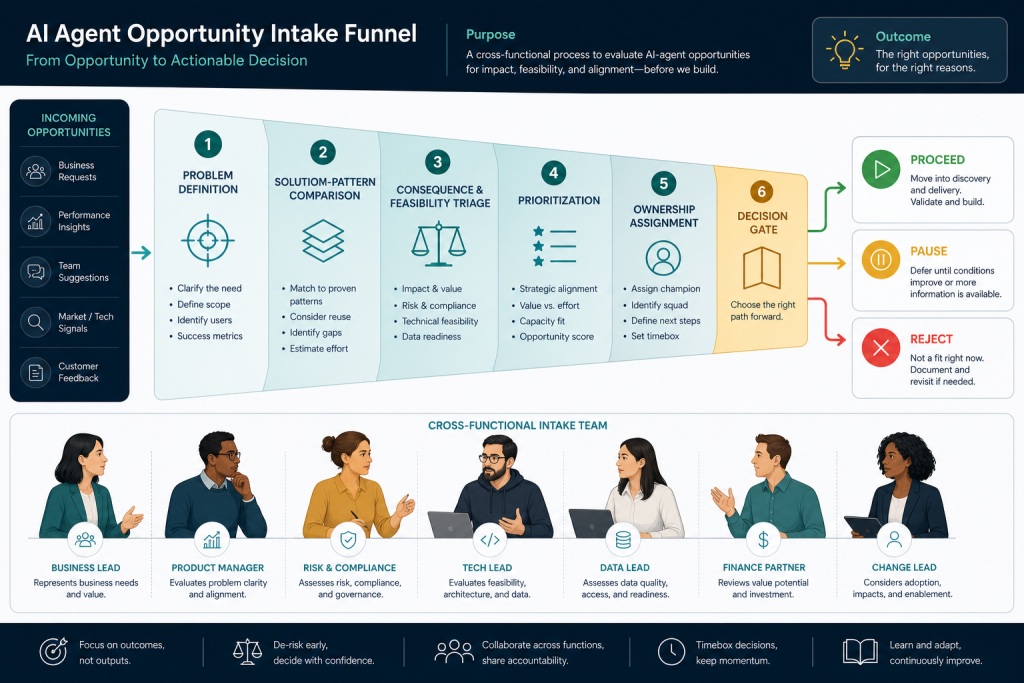
This is the operating gap an Agent Opportunity Brief addresses. It is a short intake record that gives product, operations, engineering, security, privacy, risk, finance, and frontline teams a common language before anyone commits to an implementation. Its purpose is not to predict every design decision. Its purpose is to establish enough context to make a defensible next decision: decline, return for discovery, test a lower-autonomy workflow, or advance to controlled design.
NIST’s AI Risk Management Framework treats context, intended purpose, scope, impacts, human oversight, and roles as core inputs to AI risk management. It also emphasizes that documentation supports transparency and accountability, and that the information gathered in context mapping can support an initial go/no-go decision. ([airc.nist.gov](https://airc.nist.gov/airmf-resources/airmf/5-sec-core/?utm_source=openai))
Why a shared brief is a team control—not paperwork
Without a common intake record, proposals become incomparable. One team offers a chatbot demo; another proposes automating a case handoff; a third asks for “an autonomous analyst.” Reviewers must reconstruct the workflow, infer the actual action authority, and discover dependencies informally. That makes the loudest or most technically fluent proposal appear most ready.
A brief changes the unit of discussion from the agent to the outcome, operating context, and bounded change to work. It exposes whether the proposed value requires agentic behavior at all. Some work may be better served by a deterministic rule, search-and-draft workflow, human-operated assistant, conventional automation, or process redesign. A tool-using agent is not the default answer simply because the task is multi-step.
That distinction matters because increasing autonomy can reduce handoffs and cycle time, but can also raise error propagation, security exposure, review demands, cost, latency, and recovery complexity. Anthropic’s guidance similarly recommends progressing from simpler workflows to more autonomous agents, and notes that agents can pause for human feedback or stop under defined conditions to retain control. ([anthropic.com](https://www.anthropic.com/engineering/building-effective-agents?utm_source=openai))
What to standardize, and what not to standardize
Standardize the questions, artifact structure, decision labels, and evidence categories. Every proposal should disclose the same core information, even if an answer is “unknown” or “not applicable.” This makes ambiguity visible rather than allowing it to disappear in a slide deck.
Keep thresholds and controls context-dependent. A marketing-content assistant and a system that changes account access should not carry the same approval burden. Your organization must set its own consequence tiers, risk tolerance, data classifications, approval authorities, retention requirements, and escalation paths. NIST describes the AI RMF and its playbook as voluntary, flexible resources rather than a one-size-fits-all ordered checklist. ([nist.gov](https://www.nist.gov/itl/ai-risk-management-framework/nist-ai-rmf-playbook?utm_source=openai))
Do not turn the brief into process theater. An intake form fails when teams paste generic language such as “human in the loop,” “secure,” or “improves efficiency” without identifying who reviews what, which action is blocked, or what baseline will prove improvement. Require concise, falsifiable statements. If an answer cannot yet be known, record the assumption, name its owner, and state the evidence needed to resolve it.
2. Build a brief that makes proposals comparable
The minimum comparable fields
The following fields are deliberately compact. They are not a full architecture review, privacy impact assessment, threat model, or evaluation plan. They are the minimum record needed to decide whether that deeper work is justified.
| Field | What a usable entry looks like | Weak entry to challenge |
|---|---|---|
| Outcome and baseline | “Reduce time to produce a customer-ready billing-resolution draft from 18 minutes to 8 minutes while maintaining or improving reviewer-accepted quality.” | “Automate billing support.” |
| Affected workflow and scope | Trigger, current steps, proposed changed step, in-scope case types, exclusions, and where work returns to a person. | “Help agents resolve tickets.” |
| Accountable outcome owner | A named business or operational leader who can accept the result, prioritize process changes, and own post-launch performance. | “AI team” or “everyone.” |
| Affected stakeholders | Direct users, customers, operators, approvers, teams providing data/tools, and groups that could experience downside. | “Support team.” |
| Inputs, outputs, dependencies | Sources received; outputs created; data sensitivity; systems/tools; and whether each integration is read, write, or administrative access. | “Uses CRM data.” |
| Autonomy boundary | “May retrieve records and draft a resolution. A trained support agent must approve any customer communication or credit request. It cannot submit credits.” | “Human in the loop.” |
| Success criteria | Quality, operational, risk, and human-work measures with baseline, target, measurement method, and decision owner. | “Improve accuracy and efficiency.” |
| Assumptions and evidence | “Assumption: invoice data is sufficiently complete for the selected case types. Evidence: sample audit across 100 recent cases, reconciled against final resolutions.” | “The data should be fine.” |
A named accountable owner is especially important. The owner is not necessarily the person building the system, approving a connector, or conducting an evaluation. They are the person accountable for the outcome in the workflow and authorized to accept the operating tradeoffs. Supporting roles should be recorded separately: process owner, technical owner, data owner, security reviewer, privacy/legal reviewer where applicable, and frontline operator representative.
Use four dimensions to express exposure clearly
Teams often collapse every concern into “risk.” Instead, record four distinct dimensions in plain language:
- Consequence: If the output or action is wrong, what can happen—and to whom? Include financial loss, customer harm, access loss, safety effects, confidentiality, operational disruption, and reputational impact.
- Uncertainty: How much is unknown about task conditions, data quality, expected edge cases, model behavior, tool reliability, or user adoption? An untested assumption is uncertainty, not a fact.
- Reversibility: Can a person detect and undo the result before material impact? State the time window, correction path, and who has authority to reverse it.
- Stakeholder exposure: Which people are affected, including those who do not directly operate the system? Consider whether different users or customer segments encounter different error modes or burdens.
This language is useful across roles because it describes the work, not model internals. NIST’s mapping guidance calls for documenting intended purpose and context, potential benefits and costs, stakeholders and impacts, third-party components, and defined human-oversight processes. ([airc.nist.gov](https://airc.nist.gov/airmf-resources/airmf/5-sec-core/?utm_source=openai))
3. Match evidence and review effort to the proposed change
Autonomy is an operating boundary, not a label
Terms such as “copilot,” “assistant,” and “agent” are too vague for intake. Describe what the system is permitted to do in the actual workflow. A useful four-level vocabulary is below; it is a sample organizational policy pattern, not a universal classification.
- Inform: retrieve, summarize, classify, or surface information; no action is taken in another system.
- Recommend: produce a proposed decision, plan, or draft; a person independently reviews and acts.
- Execute with approval: prepare or initiate a defined action, but a designated person must approve before the consequential step occurs.
- Execute within limits: act without case-by-case approval only within explicit scope, monetary, audience, time, and permission limits; escalate exceptions and stop on defined conditions.
For each level, the brief must identify prohibited actions, stop conditions, escalation recipient, and rollback route. This prevents a subtle but common failure: a “drafting” tool quietly gains the ability to send messages, create records, change permissions, or trigger downstream automation.
Permission design belongs in the intake because tool access determines the feasible autonomy boundary. Record every dependency and the least authority proposed: read, create draft, submit for approval, execute bounded action, or administer. Security review will later determine the actual control design. OWASP guidance for agentic applications highlights authorization boundaries for tool use and recommends explicit human approval for security-relevant changes to permissions, configurations, or infrastructure state. ([cornucopia.owasp.org](https://cornucopia.owasp.org/cards/AAI9?utm_source=openai))
Evidence required to move from idea to controlled design
At intake, the team is not proving production readiness. It is establishing whether a responsible design experiment is warranted. Require evidence matched to consequence, uncertainty, reversibility, stakeholder exposure, and proposed permissions.
- Problem evidence: workflow map; volume and variation; current baseline; examples of failure, delay, rework, or unmet user need.
- Outcome evidence: measurable success criteria, including an operational metric and at least one quality or harm-prevention measure. For the billing example: reviewer acceptance rate, time per case, unsupported-policy recommendation rate, and inappropriate-credit recommendation rate.
- Feasibility evidence: representative inputs, availability and quality of source data, confirmed system owners, and a preliminary assessment of whether necessary tools can be accessed with bounded permissions.
- Control evidence: proposed autonomy level, approval/stop/rollback design, auditability expectations, and a route for users to report bad outputs or workflow friction.
- Assumption evidence: a short register showing what is assumed, how it will be tested, who owns validation, and what result would change the decision.
For more autonomous proposals, add a preliminary evaluation approach before advancing: a representative test set or scenario set, clear pass/fail criteria, and the appropriate mix of automated, expert, and human review. Agent evaluation is difficult because agents can act over multiple turns and tools; therefore, evaluation needs to examine task outcomes and behavior across the workflow rather than only the final text. ([anthropic.com](https://www.anthropic.com/engineering/demystifying-evals-for-ai-agents?utm_source=openai))
4. Triage without creating a bottleneck
A practical triage procedure
- Submit a one-page brief. The proposer completes every required field. “Unknown” is acceptable only when paired with a validation plan.
- Run a 20-minute cross-functional triage. Confirm the outcome, scope, owner, proposed autonomy, affected stakeholders, critical dependencies, and largest unresolved assumption. Do not debate platforms.
- Choose one decision. Decline (no credible outcome or unsuitable fit); return for discovery (missing baseline, owner, scope, or dependency facts); advance as lower-autonomy workflow; or advance to controlled design.
- Write the evidence gate. Record the smallest evidence package required before the next review, who produces it, and the decision it will inform.
- Maintain the brief as a living record. Update it when scope, permissions, models, tools, stakeholder impacts, or operating context change. This links intake to later evaluation, release, monitoring, incident response, and retirement practices.
Speed comes from standardizing a small number of high-leverage questions, not from eliminating review. Low-consequence, reversible, read-only work may advance quickly. Higher-consequence or write-capable work deserves more evidence because errors can propagate farther and be harder to correct. The goal is proportionality: neither a heavyweight committee for every draft nor unreviewed autonomy for consequential actions.
For the fictional billing proposal, the appropriate intake decision is likely return for discovery, then test a recommendation workflow. The prototype may be useful, but the team lacks a measurable baseline, a bounded case taxonomy, a named owner for customer and financial outcomes, and evidence that data sources agree. It should not receive credit-issuance or customer-send permissions at this stage.
5. Practice: turn an idea into a decision-ready brief
Applied exercise: create the first Agent Opportunity Brief
Purpose: Convert a current team idea into a reviewable operating artifact. This exercise creates the first reusable entry in your AI Agent Team Operating Playbook: the approved intake template and one completed, decision-ready example.
Time: 45–60 minutes. Participants: proposer, business/process owner, technical representative, and at least one representative from operations, risk/security/privacy, or frontline users as appropriate to the proposal.
Instructions
- Select one live proposal. Do not choose a hypothetical “ideal” use case. If no live proposal is available, use the fictional billing-resolution scenario.
- Complete the brief below in plain language. Limit each response to what is needed for the next decision; do not design prompts, choose a vendor, or write architecture.
- Mark each assumption as validated, unvalidated, or disputed. For every unvalidated or disputed assumption, state the evidence owner and test.
- Have each participant independently identify the highest-consequence action and the first irreversible action. Reconcile differences in the group.
- Choose a triage outcome and write an evidence gate for the next review. If the group cannot name an accountable owner, the proposal cannot advance.
Agent Opportunity Brief template
| 1. Outcome and baseline | What observable change is sought? What happens now, how is it measured, and what target would count as success? |
|---|---|
| 2. Workflow and scope | What triggers the work? Which step changes? What is explicitly out of scope? |
| 3. Accountable owner and contributors | Who accepts the outcome? Who owns process, technology, data, controls, and frontline feedback? |
| 4. Stakeholders and exposure | Who uses, receives, approves, supports, or may be adversely affected by the result? |
| 5. Inputs, outputs, data, and tools | What enters and exits? Which systems are involved? What sensitivity and access level are proposed? |
| 6. Autonomy boundary | What may it do, what may it never do, when must it pause, and who can approve, override, or roll back? |
| 7. Consequence, uncertainty, reversibility | What can go wrong, what remains unknown, and how quickly can each material error be detected and corrected? |
| 8. Success criteria and evaluation signals | Which quality, operational, risk, and human-work measures will be used? Who judges them? |
| 9. Assumptions and evidence gate | What must be validated next, by whom, with what evidence, before controlled design? |
| 10. Triage decision | Decline; return for discovery; advance as lower-autonomy workflow; or advance to controlled design. Record rationale and next review date under your organization’s policy. |
Peer-review rubric
- Comparable: Could a reviewer compare this proposal against another without a verbal pitch?
- Owned: Is one outcome owner named and empowered?
- Bounded: Are the scope, permissions, prohibited actions, escalation, and rollback clear?
- Evidence-led: Are claims distinguishable from assumptions, with a concrete next test?
- Proportionate: Does the evidence gate reflect actual consequence and reversibility rather than generic fear or optimism?
Playbook handoff: Store the template, the completed brief, the triage decision, and the evidence gate in the shared playbook. In later modules, this same record should link to the permission matrix, evaluation plan, release gate, monitoring plan, and incident owner—so that decisions made at intake remain visible as the initiative evolves.
Build an Agent Opportunity Brief and Set Its Evidence Gate
Scenario: Fictional scenario: A customer-operations director asks the AI team to build an agent that “resolves billing problems automatically.” In a weekly intake meeting, the proposal sounds compelling until Finance asks whether the agent can issue credits, Security asks which billing and CRM permissions it needs, and Support asks who owns a wrong resolution sent to a customer. The proposer has a prototype conversation but no baseline for current resolution quality, no defined boundary between drafting and acting, and no named person authorized to accept service and financial outcomes. The team needs to decide whether to reject the proposal, return it for discovery, or advance it to controlled design.
Work in a cross-functional group. Complete one Agent Opportunity Brief for a live initiative, use the peer-review rubric to challenge vague claims, then record a triage decision and evidence gate. Add both the template and completed record to the team’s AI Agent Team Operating Playbook.
Self-review checklist
- Write the outcome as a measurable change in a workflow or user experience—not as a request to deploy an agent.
- Name one accountable outcome owner with authority to accept the operational result and residual risk.
- List users, operators, customers, and other affected stakeholders; include people who may bear a downside but are not direct users.
- Describe the proposed autonomy boundary using observable actions: draft, recommend, execute with approval, or execute within stated limits.
- Separate inputs, outputs, and tool/data dependencies; flag write access, money movement, permission changes, external communications, and regulated or sensitive data for follow-up review under organizational policy.
Key takeaways
- An opportunity brief is an intake and triage artifact, not a solution-design document: it makes proposed work comparable before teams commit to models, platforms, or integrations.
- Standardize outcome, workflow, owner, stakeholders, consequence, autonomy, dependencies, assumptions, evidence, and the next decision; leave thresholds and approval paths context-dependent.
- Use consequence, uncertainty, reversibility, and stakeholder exposure together. A low-dollar action can still be high consequence if it affects rights, safety, access, security, or customer trust.
- Require evidence proportional to the proposed autonomy and exposure. A proposal should not progress merely because a demo appears plausible.
- The accountable business owner accepts the outcome and residual operational risk; technical, security, privacy, legal, and operations partners contribute evidence and constraints rather than becoming default owners.
Useful terms
- Accountable outcome owner
- The person with authority to accept the operational outcome and residual risk of the changed workflow; they are not necessarily the technical builder.
- Agent Opportunity Brief
- A concise intake record that frames a proposed AI-agent initiative in terms of outcome, workflow, ownership, exposure, boundaries, dependencies, assumptions, evidence, and next decision.
- Autonomy boundary
- The explicit description of actions an AI system may take, actions it must not take, when it must pause or escalate, and how a person can override or reverse results.
- Controlled design
- The stage after intake in which an approved initiative receives detailed design, permissions, evaluation, security/privacy, operational, and release planning appropriate to its context.
Research & review note
This lesson is built from source-traceable research and reviewed before publication. AI Agentic School uses AI as a research and practice tool, not as a substitute for evidence or editorial judgment.