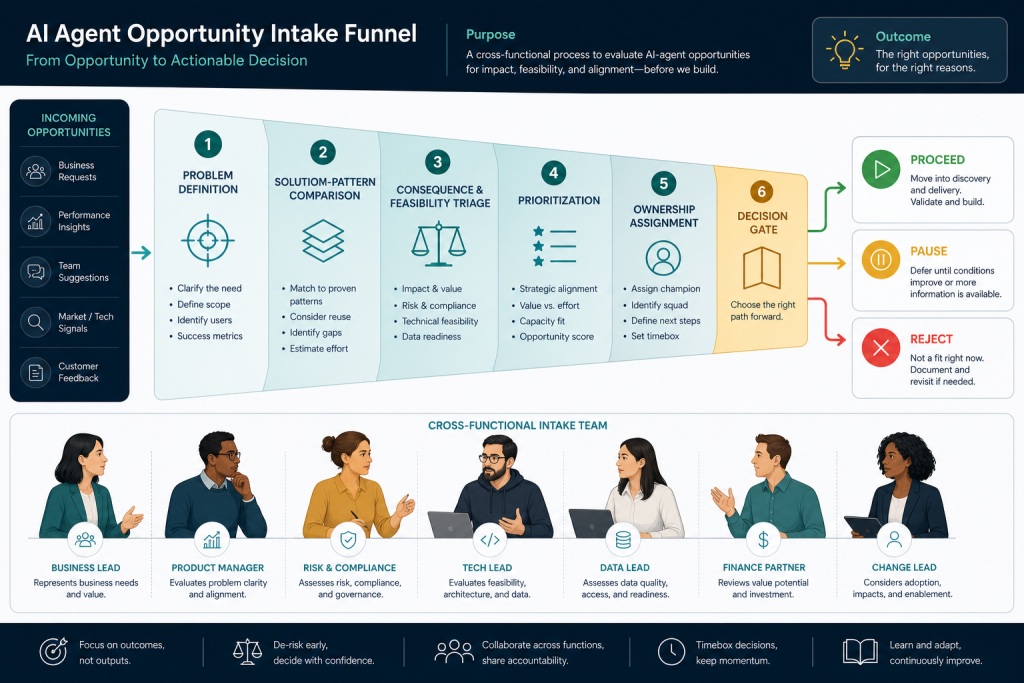
Replace enthusiasm-led experimentation with a repeatable, evidence-based method for deciding which proposed agent initiatives should proceed, which solution pattern fits, who owns the outcome, and what evidence is needed at each stage.
Module objectives
- Classify a proposed capability as a prompt, assistant, deterministic workflow, conventional automation, tool-using agent, broader agentic system, or no-build case and document the reasoning.
- Complete an opportunity intake record that states the outcome, owner, affected users, inputs and outputs, autonomy boundary, tools and data, human dependencies, consequence level, and success criteria.
- Apply suitability, feasibility, value, risk, and operational-readiness criteria to prioritize proposals and issue a documented proceed, reshape, pause, or reject decision.
- Assign accountable lifecycle ownership and identify required reviewers before experimentation begins.
Detailed topic content is generated and researched separately so each topic maintains its own source trail.
This module in 6 slides
Click through for a quick overview, or use your arrow keys.
Put this module to work
Suggested time: 3 hours
Real-world scenario
Three departments each start building AI agents on their own. Marketing picks one tool, support another, finance a third. Six months later there are eleven agents, no shared standards and nobody can say which ones touch customer data. This module sets up a shared intake process so every agent idea is judged the same way before anyone builds.
Step-by-step walkthrough
- Create a one-page intake form: problem, users, data touched, actions taken, expected benefit, risks.
- Agree on a suitability checklist: when an agent is the right pattern and when a workflow or simple tool is better.
- Define a scoring method for prioritizing ideas: value, risk, effort and data readiness.
- Name decision owners: who approves, who builds, who operates.
- Run three real ideas from your team through the process.
Common mistakes and how to fix them

I have worked with companies of every size, and the ones that adopted technology well had one simple, shared front door for requests. The same applies to AI. A light intake process saves you from a pile of unmanaged agents a year from now.
Try this
Bring one agent idea from each team member to a 30-minute meeting and score them together using your new criteria.
Before you move on
Your checklist is saved in this browser.
Agent opportunity scorer
Rate your idea on five factors and get a recommendation: agent, plain workflow, or simplify first. Your work is saved in this browser.
Autonomy envelope builder
List the actions your agent might take and sort each into Do alone, Ask first or Never. Your work is saved in this browser.