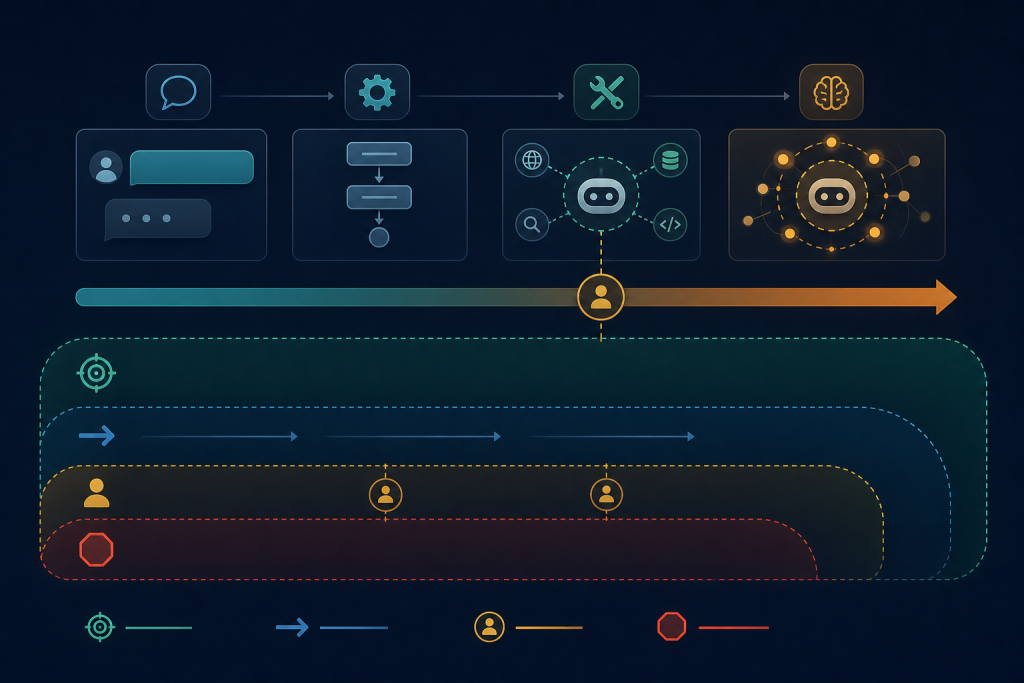
Certification domain 1 establishes professional judgment before implementation. Candidates must prove that an agent is justified, bounded, measurable, and preferable to simpler alternatives. Module Assessment 1 evaluates an independently analyzed opportunity brief and architecture-choice defense at an 85% mastery threshold.
Module objectives
- Classify a proposed solution as a prompt, assistant, deterministic workflow, automation, tool-using agent, or broader agentic system using observable characteristics rather than marketing labels.
- Produce an agent opportunity brief defining stakeholders, intended outcome, inputs, outputs, constraints, assumptions, dependencies, and evidence needed to justify implementation.
- Specify autonomy boundaries, deterministic responsibilities, permitted and prohibited actions, human-control points, unacceptable failures, and measurable success criteria.
- Defend an agent-versus-simpler-system decision and identify evidence that would trigger revision, reduced autonomy, or rejection.
Detailed topic content is generated and researched separately so each topic maintains its own source trail.
This module in 6 slides
Click through for a quick overview, or use your arrow keys.
Put this module to work
Suggested time: 4 to 5 hours, plus Module Assessment 1
Real-world scenario
A regional insurance broker asks for an AI agent to handle new claims. The candidate who passes this domain does not start by choosing a model. They write an opportunity brief showing that intake and document checks can be a deterministic workflow, that only the first-pass summary of a messy claim needs a model, and that no claim decision may ever be made without a human adjuster. That brief, not the code, is what this domain grades.
Step-by-step walkthrough
- Choose a realistic opportunity from your own work or industry. Avoid toy problems; the assessment rewards realistic constraints.
- Classify the proposed solution on the spectrum: prompt, assistant, deterministic workflow, automation, tool-using agent, agentic system. Justify the level with observable behavior, not vendor language.
- Draft the opportunity brief: stakeholders, outcome, inputs, outputs, constraints, assumptions, dependencies and the evidence you would need.
- Define the autonomy envelope: what the agent may do alone, what needs confirmation, what is prohibited, and which failures are unacceptable.
- Write the counter-argument: what evidence would make you reduce autonomy or reject the agent entirely.
Common mistakes and how to fix them

I have spent more than 25 years building systems that real customers and staff depend on: networks, e-commerce, course platforms, and lately AI agents and a robot. The projects that went well always had a clear boundary on paper before anyone built anything. The ones that went badly started with a cool tool looking for a problem. This domain is the professional habit of writing the boundary first.
Try this
Before taking Module Assessment 1, ask a colleague to argue that your problem does not need an agent. If you cannot answer them with evidence, tighten your brief.
Before you move on
Your checklist is saved in this browser.
Agent opportunity scorer
Rate your idea on five factors and get a recommendation: agent, plain workflow, or simplify first. Your work is saved in this browser.
Autonomy envelope builder
List the actions your agent might take and sort each into Do alone, Ask first or Never. Your work is saved in this browser.