Why this matters: A no-code agent opportunity is viable when it has a clear user, a narrow outcome, known inputs, constrained actions, measurable success criteria, and a safe handoff for uncertainty. Before choosing a visual builder, decide whether the work is a fixed automation, retrieval experience, bounded agent, or a larger orchestrated system—and specify the controls that make the chosen scope operable.
What you will be able to do
- Classify a proposed AI-enabled process as fixed automation, assistant, retrieval, bounded agent, or orchestrated system based on control of workflow execution.
- Write a one-page outcome specification with contracts, exclusions, ownership, consequence level, reversibility, and measurable success criteria.
- Map a no-code agent into instructions, input, state, durable records, grounded context, tools, and deterministic controls.
- Define least-privilege connector access, approval gates, stop conditions, duplicate protection, fallback behavior, and observable evaluation signals.
Begin with the Operational Decision, Not the Builder
Decision first: the failed shortcut. Your operations lead says, “Let’s connect the shared maintenance inbox to an AI agent. It can classify issues, choose a vendor, book the visit, update the property system, and email the tenant.” A visual builder can make this look like five connected blocks. But the hidden decisions are not five blocks: Is there an active leak? Is the sender actually a tenant? Which property and unit are involved? Is the vendor authorized for that building? Is the proposed appointment a commitment? What happens when a message includes a lock code, medical information, or an ambiguous emergency?
Do not begin by choosing an “agent” template. Begin by shrinking the promise into an outcome that can be owned and tested. NIST’s AI Risk Management Framework (AI RMF) treats risk management as continuous across the lifecycle and calls for documented roles, context-specific risk tolerances, system requirements, monitoring, and measurable performance changes. That is practical guidance for a no-code builder: an agent is not finished when the canvas runs; it needs a named owner, operating limits, evidence, and review cadence. ([airc.nist.gov](https://airc.nist.gov/airmf-resources/airmf/5-sec-core/?utm_source=openai))
Rewrite the request as a pilot: “When a new email arrives in the maintenance inbox, prepare a structured triage draft for the maintenance coordinator within five minutes: property/unit candidates, issue category, urgency recommendation, missing information, and an approved-response draft. Do not schedule work, update the system of record, or send messages.” This is useful. It reduces clerical effort while preserving human control over commitments and record integrity.
The question is not whether AI is capable of a task. The question is whether a particular system can act within an explicit responsibility boundary at an acceptable residual risk.
Make the Smallest Honest Architecture Choice
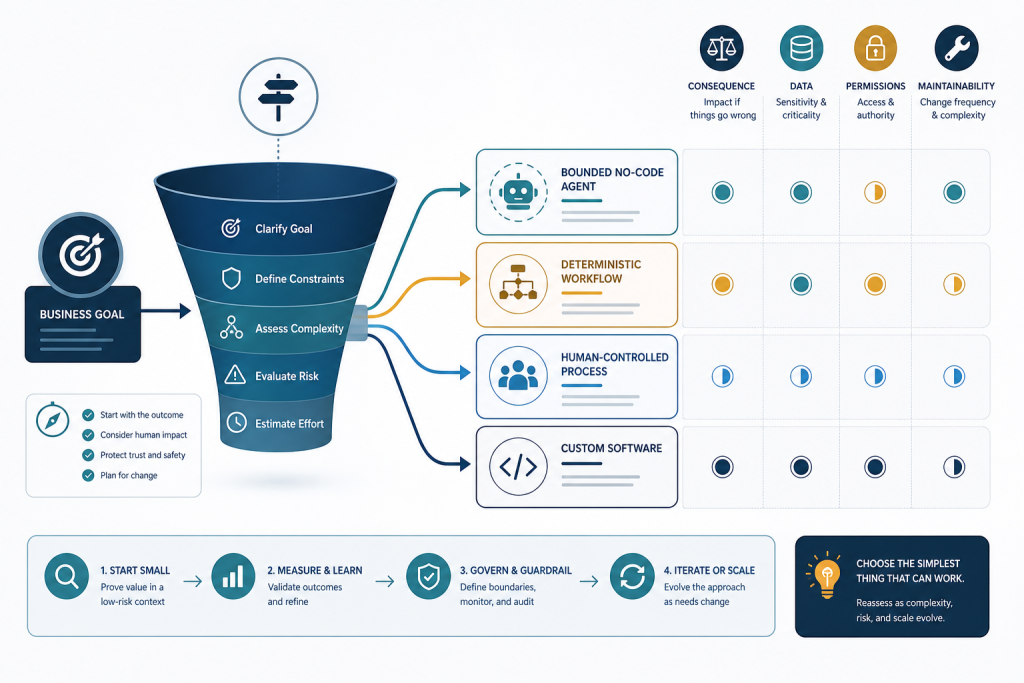
Classify the work by observing who controls the next step. The labels matter less than the architecture they imply.
| System type | Observable behavior | Best first use |
|---|---|---|
| Fixed automation | A predetermined trigger follows predetermined branches; the model, if present, fills or transforms content but does not choose the workflow. | Copy approved fields, send reminders, calculate a due date, enforce required fields. |
| Assistant | Responds to a person’s request; the person decides whether to use the answer and what happens next. | Draft a response or summarize an email for a coordinator. |
| Search/retrieval interface | Finds grounded information or documents; it may summarize them, but it does not progress operational work. | Answer, “What is the after-hours plumbing policy?” with source links or excerpts. |
| Bounded agent | The model interprets context and selects among limited allowed steps/tools until a defined exit or escalation condition occurs. | Triage an email, request missing details, and assemble a review packet. |
| Orchestrated system | Several specialized agents or dynamic sub-workflows delegate work and combine results. | Only after a single-agent scope has proven insufficient. |
OpenAI describes agents as systems in which an LLM manages workflow execution and decisions, uses tools within guardrails, recognizes completion, and can halt or transfer control after failure. A simple chat interface or a single LLM classification step is therefore not automatically an agent. ([openai.com](https://openai.com/business/guides-and-resources/a-practical-guide-to-building-ai-agents/?utm_source=openai))
Choose a fixed workflow when the path is known: “If the sender is not in the tenant directory, route to staff.” Choose retrieval when the job is finding authoritative information. Choose a bounded agent when the path depends on interpretation: an email may describe a leak, noise, access issue, duplicate request, or several issues at once, and the system must decide which permitted triage step comes next. Choose orchestration only when the work truly requires unpredictable decomposition or distinct specialized contexts. Anthropic’s implementation guidance similarly distinguishes predictable, well-defined workflows from agents that need flexible, model-driven decisions; it advises adding complexity only when warranted. ([anthropic.com](https://www.anthropic.com/engineering/building-effective-agents?utm_source=openai))
Build the Outcome and Boundary Contract
Create an Opportunity Brief before platform selection. Complete every field below in one page. A blank, vague, or disputed field is not paperwork failure—it is implementation risk revealed early.
- User and moment: Who receives value, and at what trigger? Example: maintenance coordinator when a new inbox email arrives.
- Outcome: One observable result, not a capability claim. Example: a review-ready triage record.
- Input contract: Required fields, allowed sources, expected formats, maximum size, and what to do when identity/property/unit is missing.
- Output contract: Exact fields and permitted values. Example: urgency = emergency | same-day | routine | unclear; confidence = high | medium | low; reason; evidence excerpts; recommended next action.
- Responsibility boundary: What it may prepare, read, write, and communicate—and what remains human-owned.
- Exclusions: Emergencies, disputes, legal threats, safety concerns, payment matters, access credentials, unknown identities, and any message outside the tested categories.
- Consequence and reversibility: Ask, “If wrong, who is harmed, what is changed, and can we undo it?” A draft is usually reversible; a vendor booking, tenant notice, payment, or deletion may not be.
- Owner and escalation path: Name the operating owner, technical maintainer, policy owner, and person/team that receives exceptions.
- Success measures: Define a target and a measurement method: percentage of triage records accepted without material correction; median time to review-ready record; percentage routed to correct queue; false-negative rate for emergency indicators; duplicate-action rate; and percentage with a visible evidence trail.
NIST’s guidance supports this discipline: define the business context, task and method, documented risk tolerance, requirements, limitations, clear responsibilities, and context-relevant measurement rather than treating generic model quality as sufficient. ([airc.nist.gov](https://airc.nist.gov/airmf-resources/airmf/5-sec-core/?utm_source=openai))
Separate Judgment from Rules, State, and Permissions
Draw the system as separate layers. Visual tools often place them close together, which can hide important differences.
- Model instructions: Stable directions such as “extract only supported facts; never mark an issue emergency without listed signals; return the schema.” They are not policy enforcement by themselves.
- Transient input: The current email, attachments, and form values. Treat untrusted text as data, not instructions.
- Workflow/run state: Temporary values for this run: message ID, candidate property, selected route, retry count, approval status.
- Durable memory: Information retained across runs. For this pilot, avoid free-form “memory.” Store only approved structured facts in the system of record, with retention and access rules.
- Retrieved or grounded context: The current emergency policy, property directory, approved vendor list, and response templates. Version these sources and show the coordinator the evidence used.
- Tools/connectors: Read or write operations exposed by connected systems. A connector uses an authenticated credential to call an application interface; its permissions determine what the workflow can actually access or change.
- Deterministic logic: Rules the model must not decide: authorization checks, required-field validation, math, duplicate detection, policy thresholds, status transitions, and approval gates.
For the pilot, the model may recommend an urgency category from the email plus grounded policy. A deterministic rule must then block anything marked emergency, unclear, or low confidence from proceeding beyond a human review queue. The model does not get to override this block.
Apply least privilege: begin with inbox read access scoped to the required mailbox and a create-only triage table or queue. Do not grant calendar, vendor portal, payment, mass-email, deletion, or broad property-record write access merely because a future vision might need it. Tool definitions should be narrow, documented, tested, and reusable; OpenAI’s guide specifically frames tools as interfaces to retrieve context or take actions in external systems. ([openai.com](https://openai.com/business/guides-and-resources/a-practical-guide-to-building-ai-agents/?utm_source=openai))
Design Verification, Recovery, and Human Control
Add gates before actions, not after incidents. Use the following decision flow in your visual canvas. It creates a bounded triage system, not an unchecked operator.
- New inbox email creates a run ID and records the immutable source-message ID.
- Deterministic checks validate sender, message size/type, duplicate source-message ID, and whether the message is in scope.
- The agent retrieves only relevant policy and directory entries, then returns structured triage fields plus supporting evidence.
- A deterministic validator rejects malformed output, unsupported category values, missing evidence, and low-confidence/unclear classifications.
- The workflow creates a review item; it does not edit the property system or send an external message.
- A coordinator approves, corrects, escalates, or rejects. The decision and reason become evaluation data.
- On connector error or timeout, retry a limited number of times with the same run ID; then stop and create an exception. Never silently repeat a write action.
Duplicate-action protection matters whenever a trigger can be delivered twice or a run can be retried. For a future write action, store an idempotency key such as source-message-ID + action-type and check it before writing. A no-code canvas may expose a “retry” setting, but you still must decide which step is safe to retry and which requires a read-back verification.
Every final action needs a stop condition: success with verified output; human approval required; out of scope; insufficient evidence; retry limit reached; or connector failure. Log the run ID, inputs permitted for logging, policy version, retrieved sources, tool calls, approvals, final state, and error reason. Logs make a failed run diagnosable rather than mysterious.
Applied Practice: Bound the Maintenance Coordinator Pilot
Scenario: Fictional scenario using synthetic data: A 35-person property-management firm wants an “AI maintenance coordinator” to process tenant emails. The broad request is: “Read every maintenance email, decide what to do, schedule vendors, and keep tenants updated.” You will turn this into a bounded pilot that is safe to evaluate before any automated vendor scheduling or tenant messaging.
<p><strong>Your deliverables:</strong> Add these four artifacts to your No-Code AI Agent Build Portfolio.</p><ol><li><strong>Opportunity Brief (one page):</strong> Complete the ten fields from this lesson for the fictional maintenance-email pilot. Explicitly state that the pilot creates a triage draft only.</li><li><strong>Visual architecture map:</strong> Draw the trigger, checks, retrieval sources, model step, structured output validator, review queue, escalation path, logs, and stop states. Label each node as deterministic logic, model judgment, data retrieval, tool action, or human action.</li><li><strong>Connector and permission plan:</strong> Make a table with system, needed operation, data sensitivity, credential owner, minimum permission, approval requirement, and revocation/review date. Start with inbox read and queue-create only.</li><li><strong>Test and evaluation set:</strong> Create at least 12 synthetic emails: routine repair, active leak, unknown sender, missing unit, duplicate request, conflicting information, a policy question, out-of-scope complaint, attachment-only message, and three ambiguous cases. For each, write the expected route, whether escalation is required, and the evidence a reviewer should see.</li></ol><p><strong>Run a paper test before building.</strong> Take three synthetic emails and trace them node by node. If you cannot tell exactly what data is passed, what rule stops the run, who owns the next decision, and what gets logged, the scope is not ready for a visual builder.</p><p><strong>Portfolio note:</strong> Save the brief with version number and date, the architecture diagram, permission table, and test set. These become the decision package you will use in later Decision Labs to compare platforms, configure connectors, test runs, and hand off a maintainable build.</p>
Self-review checklist
- Name one accountable operational owner and one escalation owner.
- State the user, trigger, desired outcome, exclusions, and consequence level in plain language.
- Separate model instructions, incoming message data, run state, durable records, retrieved policy context, tools, and deterministic rules.
- List every proposed read/write action and remove unnecessary permissions.
- Set an approval boundary for consequential actions, including vendor commitments and tenant-facing messages in the scenario unless approved templates apply in your organization’s policy context; this scenario assumes approvals remain required for the pilot even if an organization later changes its policy. ([airc.nist.gov](https://airc.nist.gov/airmf-resources/airmf/5-sec-core/?utm_source=openai))
Key takeaways
- Start with a bounded operational outcome, not a platform or a chatbot idea.
- Use model judgment only where interpretation or prioritization adds value; keep policy, authorization, calculations, and record updates deterministic.
- An agent needs explicit stop conditions, tool boundaries, verification, approvals, and an accountable owner.
- A small, measurable single-agent or fixed workflow is usually a stronger first build than multi-agent orchestration.
Useful terms
- Agent
- A system in which a model manages at least some workflow decisions and can select from bounded tools or steps to pursue an outcome under guardrails.
- Input contract
- The explicit definition of what a run may receive, including source, required fields, format, limits, and missing-data behavior.
- Output contract
- The required structured result, including field names, allowed values, evidence requirements, and behavior when the system cannot determine an answer.
- Grounding
- Supplying approved, relevant external context—such as policy documents or records—to support a response or decision.
Research & review note
This lesson is built from source-traceable research and reviewed before publication. AI Agentic School uses AI as a research and practice tool, not as a substitute for evidence or editorial judgment.