Establish an accurate, version-pinned ADK mental model and implement the smallest useful agent before introducing tools or multi-agent complexity.
Module objectives
- Verify the workshop SDK version, supported languages, reference implementation, and language-specific assumptions against current official documentation and release notes.
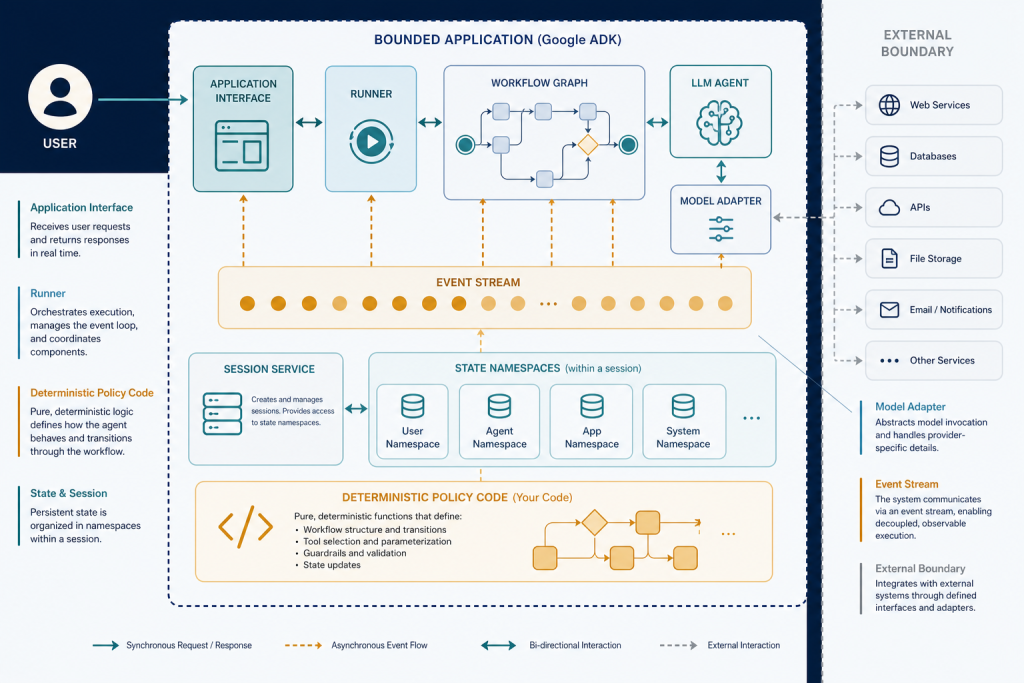
- Explain the responsibilities of agents, models, instructions, runners, workflows, events, sessions, state services, and deterministic application code.
- Implement and run a small bounded agent with inspectable events and explicit session identifiers.
- Decide when a direct model call, deterministic function, single ADK agent, or larger agent system is warranted.
Detailed topic content is generated and researched separately so each topic maintains its own source trail.
This module in 6 slides
Click through for a quick overview, or use your arrow keys.
Put this module to work
Suggested time: 3 to 4 hours
Real-world scenario
A developer builds their first Google ADK agent and gives it a long instruction covering everything: tone, policy, pricing and what to do with refunds. It works in the web UI, then makes inconsistent decisions in production. This module sets the foundation: how ADK runs an agent, how to write instructions with clear boundaries, and which decisions belong in deterministic code instead of the model.
Step-by-step walkthrough
- Set up the current ADK version in a fresh environment, following the official quickstart.
- Create a minimal agent with a model, name, description and instruction, and run it with the dev UI and the CLI.
- Trace one run: how the runner, session and events fit together.
- Rewrite the instruction into labeled sections: role, scope, rules, escalation and output.
- List the decisions in your use case that should be code, not model judgment.
Common mistakes and how to fix them

I always start a new platform by watching exactly what it does on one simple request, step by step. With ADK, that means reading the events. Once you understand one run end to end, everything you build on top is easier to debug.
Try this
Give your agent an instruction that conflicts with a tool’s behavior. Watch the events to see which one wins, and fix the conflict.
Before you move on
Your checklist is saved in this browser.
Agent opportunity scorer
Rate your idea on five factors and get a recommendation: agent, plain workflow, or simplify first. Your work is saved in this browser.
Autonomy envelope builder
List the actions your agent might take and sort each into Do alone, Ask first or Never. Your work is saved in this browser.