Why this matters: A repeatable intake process turns agent ideas into evidence-backed portfolio decisions. This lesson teaches teams to score comparatively while recording uncertainty, apply proportional evidence gates, assign explicit decision rights, and name lifecycle owners who can operate the agent after launch.
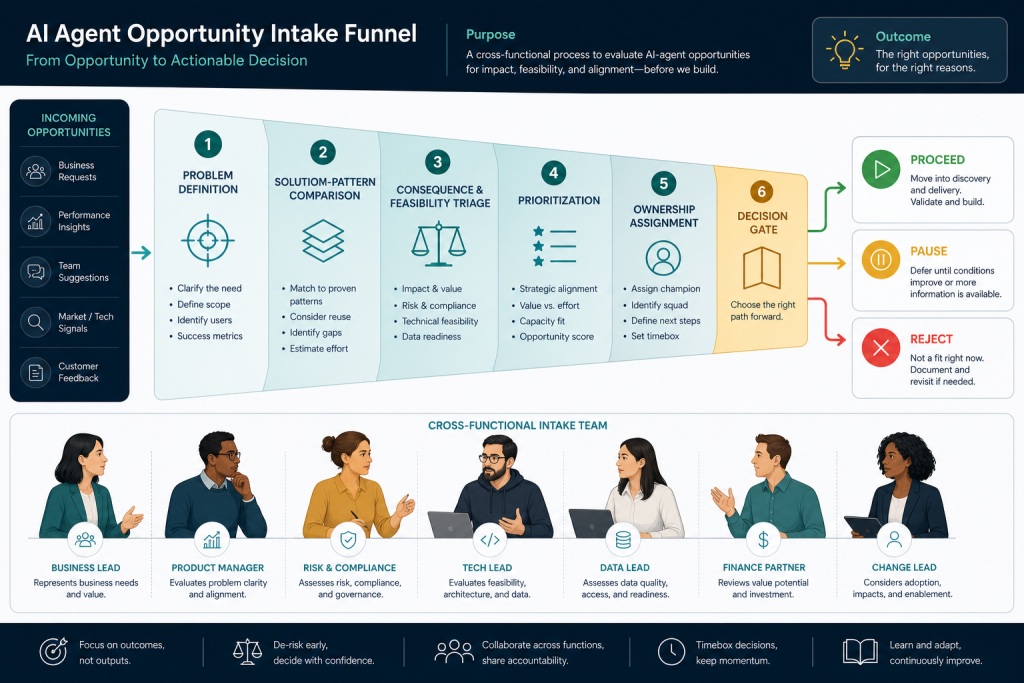
What you will be able to do
- Compare proposed agent initiatives with a transparent, anchored rubric that records evidence and uncertainty.
- Apply proportional evidence gates and distinguish a conditional discovery decision from production authorization.
- Assign recommendation, approval, veto, escalation, and consultation rights without collapsing them into a single sponsor role.
- Create a lifecycle ownership map that includes post-launch operational, technical, control, and human-review responsibilities.
The operating gap: demos are not decisions
Monday’s intake meeting looks productive—until it becomes a delivery failure six weeks later. The HR-policy assistant receives approval because its demo is polished. The payment-change agent receives approval because Finance estimates large savings. The inventory agent is approved because Operations wants speed. Then the HR sponsor changes roles; Finance learns that submitting a change is materially different from drafting one; and the inventory team cannot tell whether a proposed transfer improved availability or merely shifted stockouts elsewhere.
The failure was not that the teams lacked ideas or technical skill. They lacked a shared way to compare proposals, expose assumptions, decide who had authority, and establish who would run each service after launch. A repeatable intake practice is a portfolio control: it allocates scarce engineering, subject-matter-expert, security, and reviewer capacity toward initiatives whose benefits, risks, and evidence are legible.
NIST’s AI Risk Management Framework (AI RMF) supports this lifecycle view: governance is cross-cutting; roles and communication lines should be documented; systems should be tested before deployment and regularly while operating; and decisions about whether to proceed should be made using mapped and measured risks. ([airc.nist.gov](https://airc.nist.gov/airmf-resources/airmf/5-sec-core/?utm_source=openai))
What intake must standardize—and what it must not
Standardize the decision language, not every use case. Every proposal should use the same minimum intake record, scoring anchors, evidence labels, decision rights, and decision outcomes. That consistency lets a team compare a low-consequence knowledge assistant with a potentially consequential action-taking workflow without forcing them into identical technical designs.
Keep context-dependent: score weights, acceptable residual risk, mandatory reviewers, human-approval points, monitoring depth, and release thresholds. These are organization-specific policy choices shaped by the workflow, the people affected, existing controls, and risk tolerance. They are not universal legal requirements.
Avoid process theater. Do not require a 20-page risk document for a read-only internal assistant that only searches an approved knowledge base. Equally, do not let a neat spreadsheet substitute for proof when an agent can change payments, communicate externally, or make decisions that materially affect people. The appropriate review burden rises with consequence, autonomy, sensitive-data exposure, irreversibility, uncertainty, and operational load.
Score transparently without false precision
A proportional triage rubric
Use a weighted rubric as a conversation aid and comparison tool, not as an automatic approval engine. A total score can reveal tradeoffs, but it cannot cancel a hard stop. For example, high expected value does not make an unowned, untestable payment agent ready to proceed.
| Dimension | What the team assesses | Example anchored evidence |
|---|---|---|
| Expected value and user benefit | Magnitude of the problem, frequency, affected users, and plausible benefit. | Observed workflow volume, baseline cycle time, error/rework pattern, user interviews. |
| Feasibility and data/tool readiness | Whether the workflow, sources, integrations, permissions, and exception paths are sufficiently defined. | Named source of truth; sandbox access; tested read/write tool path; known data-quality limits. |
| Evaluability | Whether success and harmful failure can be judged with representative cases. | Outcome rubric, labeled examples, human review method, test environment, acceptance threshold. |
| Consequence and control need | Impact if the agent is wrong, misused, unavailable, or over-authorized. | Action reversibility, monetary exposure, user impact, external communication, data sensitivity. |
| Operational burden and human workload | On-call, escalation, content upkeep, quality sampling, incident handling, and reviewer time. | Named queue owner, expected exception volume, monitoring plan, training and coverage estimate. |
| Lifecycle ownership | Whether accountable owners have authority, capacity, and incentives to operate the service. | Named business accountable owner, service owner, technical owner, control owners, succession plan. |
Use coarse scales. Score each dimension from 1 to 5 with written anchors—for example, a 1 in evaluability means “success cannot yet be judged reliably”; a 3 means “a representative test set and human review method exist but coverage is incomplete”; a 5 means “outcomes, major failure modes, and monitoring signals are testable in a realistic environment.” Coarse bands discourage manufactured precision.
Record confidence separately. Mark each score as high, medium, or low confidence and write the evidence source plus the largest unknown. A proposal with a score of 20/25 but mostly low-confidence assumptions is not equivalent to one with a score of 18/25 supported by workflow data and a tested prototype. Report both the weighted score and the uncertainty profile.
Set hard stops before scoring. Typical organization-specific examples include: no accountable service owner; no approved or appropriate data/tool-access route; action cannot be reversed or reviewed at a suitable point; no credible way to evaluate the intended outcome; or a proposal conflicts with an established policy. A hard stop produces pause, reshape, or reject, rather than a debate about whether other benefits compensate for it.
For action-capable agents, assess tools by their read/write access, reversibility, permissions, and financial impact. This supports explicit limits and escalation for higher-risk actions rather than treating every integration as equivalent. ([openai.com](https://openai.com/business/guides-and-resources/a-practical-guide-to-building-ai-agents/?utm_source=openai))
Make approval conditional, staged, and auditable
Evidence gates: convert uncertainty into next actions
An intake decision should answer two questions: what may this team do next? and what must it prove before the following stage? This prevents a vague “yes” from being mistaken for permission to connect production systems or release externally.
- Gate 0 — Frame: Define the user, workflow boundary, desired outcome, non-goals, affected parties, and the simplest non-agent alternative. Confirm why agentic behavior is necessary; a deterministic workflow may be preferable when the work is stable and rule-based.
- Gate 1 — Triage: Apply the rubric, flag hard stops, assign provisional decision rights, and choose proceed to discovery, reshape, pause, or reject.
- Gate 2 — Prove: Demonstrate source and tool readiness; document the permission matrix; evaluate representative normal, ambiguous, and failure cases; define human intervention and rollback. The evidence required scales with the risk tier.
- Gate 3 — Release: Confirm named operational coverage, release criteria, monitoring, incident workflow, user communication, and a change-control route. Release is a decision to operate a service, not merely to deploy software.
- Gate 4 — Continue, change, or retire: Periodically review value, quality, incidents, cost, reviewer load, source/tool changes, and ownership. Decide whether to expand, constrain, improve, pause, or decommission.
NIST describes risk management as continuous across the lifecycle and calls for planned monitoring, periodic review, inventory, and safe decommissioning practices. It also emphasizes that measurement can use quantitative, qualitative, or mixed methods and should include uncertainty where relevant. ([airc.nist.gov](https://airc.nist.gov/airmf-resources/airmf/5-sec-core/?utm_source=openai))
Minimum intake artifact:
- Workflow/problem statement and baseline evidence.
- Proposed agent boundary: what it may read, recommend, draft, execute, and never do.
- Users and affected parties, including who can challenge or correct an outcome.
- Data and tools: source of truth, classification, access method, permissions, retention/logging considerations, and known limitations.
- Rubric scores, weights, confidence labels, hard stops, and evidence links.
- Initial evaluation claim: “We will know this is useful/safe enough when…”
- Named decision and lifecycle roles, next gate, required evidence, and review date.
Assign authority and lifecycle accountability
Decision rights: recommendation is not approval
RACI alone is often too vague for agent intake because “accountable” does not distinguish approval authority from a control function’s ability to block unsafe access. Use decision rights by decision type.
| Right | Purpose at intake | Typical holder |
|---|---|---|
| Recommend | Build the case, complete the intake, propose scope and next gate. | Product/workflow lead with technical lead. |
| Approve | Commit budget/capacity and accept the proposed risk and operating model within delegated authority. | Business accountable owner; portfolio authority for higher tiers. |
| Veto / control approval | Block or condition a proposal within a defined control domain. | Security, privacy, legal/compliance, data owner, or platform owner—only where their domain is implicated. |
| Escalate | Resolve conflicts, exceptions, or residual risk beyond delegated authority. | Named risk or executive decision forum. |
| Consult | Supply expertise before the decision; does not silently become approval authority. | Frontline users, operations, finance, accessibility, procurement, support, audit, domain experts. |
Define veto scope narrowly enough to remain workable: for example, a data owner may approve data access but not decide whether an initiative has strategic value. Conversely, the business sponsor may approve value and operating funding but cannot override a security requirement through enthusiasm. Record disagreements, the escalation owner, and the final rationale.
Cross-functional input is not ceremony. NIST calls for documented roles and clear lines of communication, executive responsibility for risk decisions, and decision-making informed by diverse disciplines and perspectives. ([nvlpubs.nist.gov](https://nvlpubs.nist.gov/nistpubs/ai/nist.ai.100-1.pdf?utm_source=openai))
Ownership after launch: sponsor, service owner, and operators
“The project is owned by Operations” is insufficient. Name at least these roles:
- Business accountable owner: owns the outcome, budget, priority, acceptable tradeoffs, and decision to continue or retire.
- Service owner: owns day-to-day service health, backlog, change coordination, dependency review, and operating documentation.
- Technical owner: owns reliability, integrations, deployment, evaluation execution, telemetry, rollback capability, and defect remediation.
- Workflow/control owner(s): own source-policy changes, tool authorization, data quality, approval rules, and control exceptions in their domains.
- Human-review owner: owns the escalation queue, reviewer guidance, staffing/coverage, and feedback routing.
One person may hold more than one role in a small deployment, but the responsibilities must still be explicit. Before release, ask: Who receives an escalation at 4 p.m. Friday? Who can disable the agent or revoke a tool permission? Who updates the source policy? Who decides whether a recurring failure warrants a product change, a control change, or retirement? If answers are absent, the initiative is not operationally ready.
Human intervention is especially important early in deployment and for actions that are high-risk, sensitive, irreversible, or exceed defined failure limits. ([openai.com](https://openai.com/business/guides-and-resources/a-practical-guide-to-building-ai-agents/?utm_source=openai))
Sources
Source list
- NIST, AI Risk Management Framework Core—governance, lifecycle monitoring, documented oversight, measurement, and proceed decisions. ([airc.nist.gov](https://airc.nist.gov/airmf-resources/airmf/5-sec-core/?utm_source=openai))
- NIST, Artificial Intelligence Risk Management Framework (AI RMF 1.0)—documented responsibilities, executive accountability, multidisciplinary decision-making, measurement uncertainty, and ongoing evaluation. ([nvlpubs.nist.gov](https://nvlpubs.nist.gov/nistpubs/ai/NIST.AI.100-1.pdf?utm_source=openai))
- OpenAI, A practical guide to building agents—tool-risk factors, layered controls, and conditions for human intervention. Vendor-specific guidance; apply principles using your organization’s approved platform and policies. ([openai.com](https://openai.com/business/guides-and-resources/a-practical-guide-to-building-ai-agents/?utm_source=openai))
Portfolio Triage Lab: Decide the Next Gate, Not Just the Winner
Scenario: Fictional scenario: A regional retailer has received three requests in the same quarter: (1) an HR-policy assistant that answers employees using approved policy documents; (2) a finance agent that can draft and submit vendor-payment changes; and (3) a store-operations agent that reads support tickets, proposes inventory-transfer actions, and sends approved actions to the inventory platform. Leadership wants visible progress within 60 days. The intake committee previously approved initiatives based on persuasive demos. One pilot then stalled because the business sponsor left, there was no one to review escalations, and the team discovered too late that the source data was inconsistent. The committee must now make transparent portfolio decisions with limited engineering and subject-matter-expert capacity.
<p><strong>Time:</strong> 45–60 minutes. <strong>Team:</strong> 4–6 people representing business/workflow, product, engineering/platform, security/privacy or data governance, and operations/support.</p><h2>Deliverable for the AI Agent Team Operating Playbook</h2><p>Create a one-page <strong>Agent Portfolio Intake and Gate Decision Record</strong>. This becomes the first reusable artifact in your team’s accumulating AI Agent Team Operating Playbook.</p><h2>Step 1: Triage the three fictional proposals</h2><p>Use the scenario proposals: HR-policy assistant, payment-change agent, and inventory-transfer agent. For each, assign a 1–5 score for the six dimensions in this lesson using the example weights shown in the visual. For every score, add:</p><ul><li>confidence: high, medium, or low;</li><li>one supporting fact or assumption;</li><li>the largest missing evidence item; and</li><li>any hard stop.</li></ul><p>Do not invent operational data. Where facts are absent, mark the score low confidence and state what evidence would change it.</p><h2>Step 2: Choose a decision and define the next gate</h2><p>For each initiative, choose exactly one outcome:</p><ul><li><strong>Proceed:</strong> advance to a defined discovery/proof gate under stated limits.</li><li><strong>Reshape:</strong> narrow the workflow, remove action authority, change access, or redesign human review before advancing.</li><li><strong>Pause:</strong> hold pending an owner, dependency, source-data improvement, or decision from an escalation authority.</li><li><strong>Reject:</strong> stop because the problem is unsuitable, the benefit is insufficient, or an unacceptable condition cannot be resolved.</li></ul><p>State what the team is authorized to do next. Example: “Proceed to a read-only sandbox prototype; no production HR-system access and no employee-specific recommendations.” Then list the minimum evidence required to pass the next gate.</p><h2>Step 3: Complete the decision-rights and ownership map</h2><p>For the selected top-priority initiative, name roles—not necessarily people—for:</p><ul><li>recommender;</li><li>approval authority;</li><li>control veto/conditional approval holders and their defined scope;</li><li>escalation authority;</li><li>consulted groups;</li><li>business accountable owner, service owner, technical owner, workflow/control owner, and human-review owner.</li></ul><p>Add two operational commitments: (1) the trigger and owner for disabling or constraining the agent, and (2) the cadence and owner for reviewing quality, incidents, human workload, cost, and source/tool changes.</p><h2>Step 4: Run a five-minute challenge review</h2><p>One participant acts as the portfolio chair and asks: “What evidence would reverse this decision?” “Whose workload is being created?” “What decision is irreversible?” “Who owns the service after the pilot team disbands?” Revise the record when the challenge exposes an unsupported assumption.</p><h2>Definition of done</h2><p>Your record is complete when a colleague who did not attend the discussion can identify the chosen decision, why it was made, uncertainty that remains, who can authorize the next action, and who will own the agent during normal operations, incidents, and retirement.</p>
Self-review checklist
- Create one intake record per proposed agent, including workflow boundary, intended outcome, affected users, tools, data, and accountable owners.
- Score every initiative using anchored 1–5 bands and attach an evidence/confidence label to every score.
- Identify hard-stop conditions before calculating a total score: prohibited action, absent accountable owner, unavailable lawful/approved data path, or no credible evaluation path.
- Assign recommendation, approval, veto, escalation, and consultation rights by decision type.
- Issue one portfolio decision—proceed, reshape, pause, or reject—with named evidence required for the next gate and a review date.
Module capstone: apply the module in the AI Agentic School Decision Lab below. Mastery unlocks the LearnDash completion control for this topic.
AI Agentic School Decision Lab
Please sign in to submit your module decision and receive feedback.
Key takeaways
- Use a small number of anchored dimensions and confidence labels to compare opportunities without pretending early estimates are precise forecasts.
- Separate recommendation, approval, veto, escalation, and consultation rights; a single project sponsor should not silently hold all five.
- Treat an agent as a lifecycle service: the accountable business owner, operational owner, technical owner, and control owners must be named before launch.
- Evidence gates should be proportional to consequence, access, reversibility, uncertainty, and operating burden—not a universal bureaucracy.
- A decision record is valuable only when it changes resourcing, permissions, evaluation scope, release conditions, or ownership.
Useful terms
- Evidence gate
- A decision point that limits what a team may do next until specified evidence is reviewed by the appropriate authority.
- Hard stop
- A condition that prevents advancement regardless of an initiative’s weighted score, such as missing accountable ownership or no credible evaluation path.
- Confidence label
- A high, medium, or low indication of how well a score is supported by evidence; it prevents assumptions from masquerading as facts.
- Control veto
- A defined authority to block or condition a decision within a specific domain, such as data access or security—not a general power to set portfolio priority.
Research & review note
This lesson is built from source-traceable research and reviewed before publication. AI Agentic School uses AI as a research and practice tool, not as a substitute for evidence or editorial judgment.